
Introduction
Nepal’s economy leans heavily on tourism, which contributes roughly 6.7% to 8% of GDP and draws over a million visitors in a good year. This dependence means that any crisis – natural or man-made – can deal a severe blow to livelihoods. In the past decade, Nepal has weathered multiple shocks: the devastating 2015 Gorkha earthquake followed by an Indian border blockade the same year, the COVID-19 pandemic in 2020, and most recently the youth-led “Gen Z” protests in 2025. Each of these events triggered sharp drops in tourist arrivals, as shown in Table 1, undercutting an industry that is a lifeline for the country.
Table 1. September Tourist Arrivals Before vs. After Shocks in Nepal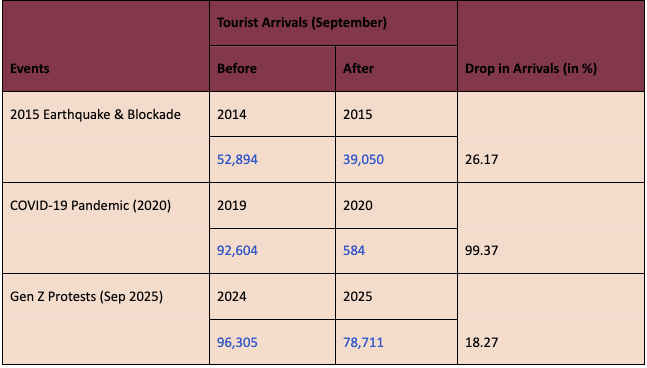
Figure 1. Tourist Arrivals Before vs. After Major Shocks in Nepal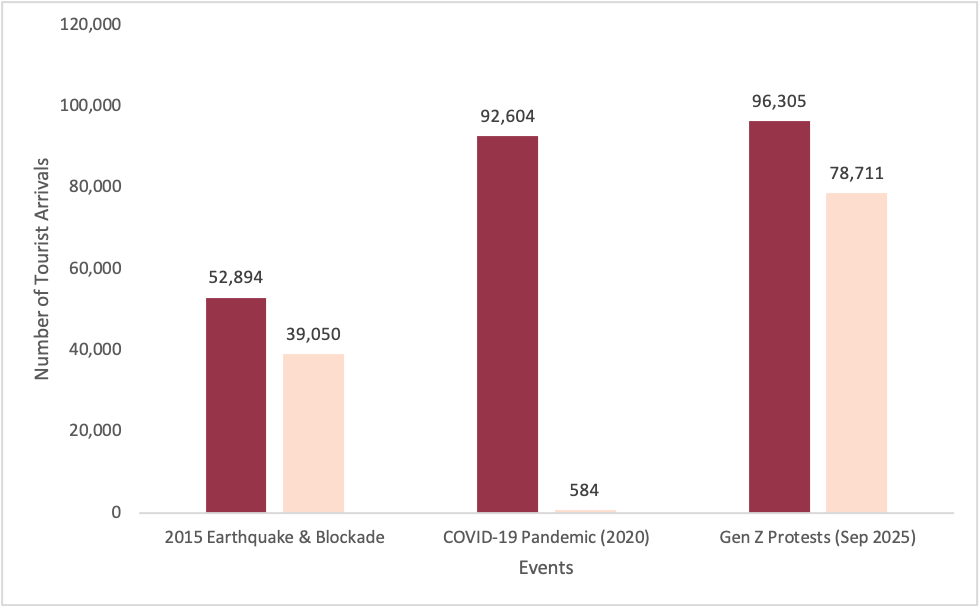
Source: Nepal Tourism Board
In early September 2025, a youth-led anti-corruption uprising, popularly known as the “Gen Z” movement, erupted into one of Nepal’s deadliest unrest in decades, leaving 74 people dead and over 2000 injured. Following the killings of multiple peaceful protestors, the Home Minister and Prime Minister resigned, infrastructure was damaged, and an interim government was formed with former Chief Justice Sushila Karki at the helm of it along with the dissolution of the Parliament. All of this happened on the eve of the peak tourist season and affected the sector greatly.
- Economic and Physical Impact
The immediate economic shock was severe. The protests hit right as Nepal entered its autumn peak season (September to November), when more than one-third of annual visitors typically arrive. According to certain estimates, there was a 30% drop in arrivals as a result of the protests. Curfews, airport closures, and violent unrest forced mass cancellations, wiping out bookings and revenue across hotels, airlines, and tour operators. Physical damage in the tourism sector was also severe. The Hilton Hotel was torched, and other tourism properties were vandalized in major cities including the Hyatt Hotel in Kathmandu. Total sector losses are estimated to have exceeded NPR 25 billion (~USD 177 million). The destruction harmed investor confidence and highlighted the industry’s vulnerability to sudden political shocks.
- Impact on Tourist Perceptions
The Gen-Z protests sparked a global crisis of perception for Nepal’s tourism. India, United States and some other countries ended up issuing travel warnings. Such advisories, even if short-lived, can have a mid-term impact by spurring trip cancellations and discouraging bookings until the warnings are lifted. Many tourists were frightened by the sudden eruption of violence. Hundreds of travelers found themselves trapped at the Kathmandu airport during the curfew, camping out on the terminal floor until flights resumed. Some visitors who had planned cultural tours or treks saw their itineraries derailed by road blockades and security lockdowns. Travel groups in city hotels were also confined indoors for safety for a couple of days. Inevitably, a number of tourists cut their trips short or decided to postpone Nepal travel plans.
After things cooled off, however, the travel industry and diaspora revived the “#NepalNow – Still Amazing, Still Open” social media campaign, sharing photos of happy travelers in unaffected areas to show that Nepal was still welcoming visitors. Such efforts aim to prevent a longer-term reputational scar.
- Government and Policy Response
The Gen-Z protest also tested the government’s crisis management. In the immediate term, authorities’ priority was to restore order. The government imposed curfews in Kathmandu and other flashpoints, mobilized armed police and the army, and by the third day had largely suppressed the riots. These steps, while necessary for safety, effectively shut down tourism activity for the duration of the emergency. The Nepal Tourism Board (NTB) coordinated with the private sector to announce that Nepal was “back in business” and safe for tourists once the streets calmed. Special shuttle buses with security escorts were arranged to ferry stranded tourists from hotels to the airport even during curfew hours – a gesture to show that visitor safety was a government priority. The fact that prominent sites and infrastructure were functioning soon after (for instance, flights resumed and popular trekking areas were unaffected by the unrest) was messaged out in press releases. Such immediate government actions, including curbing violence and then signaling stability, were crucial in preventing a total collapse of tourist confidence. On the policy front, NTB quickly stepped in to assess the scale of claims for damaged property.
While the government response was immediate and effective, it also revealed gaps in policy response. As a result, policymakers also floated ideas like establishing an emergency fund for tourism or mandating business interruption insurance for hotels. With national elections scheduled for March 2026, the government is also under pressure to ensure political stability and tourism operators have openly urged all parties to avoid disruptive street agitations in the run-up to the polls, lest the recovering industry be hit with another shock.
Building Resilience in Nepal’s Tourism
Having endured a string of shocks, from natural disasters to civil unrest, Nepal’s tourism industry must now apply the lessons learned to better navigate future risks. The goal is not only to recover from this crisis, but to emerge stronger and more prepared for future crises. The following points outline some key steps and lessons for various stakeholders, drawing on Nepal’s own past experiences and examples from other countries that faced political turmoil.
- Restoring Confidence and the Role of Diaspora
Restoring confidence in international tourists about Nepal should be a major priority for the country. This requires a concerted effort in messaging and tangible reassurance. The Nepali diaspora can also play a powerful role here. After the 2015 earthquake, Non-Resident Nepalis (NRNs) and friends of Nepal rallied to support tourism with many coming to Nepal with their families on holiday as a sign of solidarity and promoting campaigns like “Visit Nepal, Help Nepal” to boost the economy. A similar approach can help now. Nepal’s diaspora, as well as expats who love Nepal, should be encouraged to visit in the upcoming seasons, bringing much-needed business and creating positive word-of-mouth. Their authentic stories and social media posts can counteract lingering negative images. For instance, within days of the Gen Z unrest, Nepali tourism veterans launched the #NepalNow campaign online, featuring travelers proudly holding signs saying “We are in Nepal Now”. Such grassroots marketing, amplified by diaspora networks, sends the message that the situation has normalized.
In parallel, the government and industry must deliver visible signs of safety. This could include maintaining a higher security presence in tourist-frequented areas without being overbearing and installing better emergency communication systems like SMS alert services for visitors. Additionally, clear travel information should be provided such as issuing public advisories when curfews are completely lifted, when all transport is fully operational, and that no tourist sites are off-limits. Embassies abroad can then update or remove their travel warnings accordingly.
- Embracing Insurance and Strengthening Risk Financing
The Gen-Z protests underscored that in a shock-prone country like Nepal, insurance is a necessity, not a luxury. To build financial resilience, both the government and private sector must act. The government can incentivize tourism insurance uptake through tax discounts or subsidized loans for small operators. It could also establish a public-private disaster insurance pool to ensure liquidity during crises – a model used globally. Nepal Insurance Authority (NIA) is exploring such ideas, recognizing that uninsured losses threaten the broader economy.
Tourism businesses must also urgently reassess coverage. Hotels, airlines, and tour operators should ensure protection against political unrest, earthquakes, and business disruptions. The recent crisis may also encourage wider adoption of Strike, Riot, Civil Commotion (SRCC) coverage and improved insurance literacy. Industry bodies can further help by organizing insurer workshops for members.
Insurers, too, should adapt by designing tailored tourism packages bundling property, liability, and business interruption cover. Discounts could reward clients who invest in safety upgrades. With over NPR 23 billion in Gen Z-related claims, insurers will likely advocate for stronger building codes and emergency readiness.
Reinsurers and possible government guarantees may also play a larger role. A culture of “risk financing,” i.e. saving, insuring, and planning, is now essential. Strengthened by these reforms, Nepal’s tourism sector can better withstand future shocks.
- Contingency Planning in Hospitality and Travel Businesses
The Gen-Z protests revealed the urgent need for contingency planning in Nepal’s tourism sector. Most hotels and travel agencies were unprepared for nationwide unrest — a gap that must be addressed as “black swan” events become part of doing business. Tourism enterprises should develop emergency protocols to handle civil disorder, including securing premises, caring for stranded guests, and communicating with stakeholders like embassies and airlines. Some Kathmandu hotels effectively improvised during the crisis, providing meals and updates to guests. Institutionalizing such practices through staff training and written plans, covering scenarios like curfews, airport closures, or road blockades, is essential.
Tour operators should also prepare alternate routes, have rapid communication templates ready, and maintain emergency contact directories. During the unrest, for example, coordination within the industry proved valuable with hotels and agencies informally shared real-time updates and pooling transport. This can be formalized through crisis-response committees with destination-based focal points.
Flexibility is another key point. Businesses can reduce vulnerability by diversifying services across regions and seasons. For instance, targeting domestic tourists during downturns helped some hotels stay afloat post-protests. A business continuity mindset, i.e. planning “Plan B and C” scenarios, enables a calm, efficient response during future crises. Regular drills and updated risk plans will help Nepal’s tourism operators build muscle memory for resilience.
- Diversifying Risk and Future Strategy
Nepal’s heavy reliance on a few key tourism hotspots and seasons makes the sector highly vulnerable to disruptions. To reduce this risk, the country must diversify its tourism base geographically and seasonally. Promoting lesser-known destinations, like sites in western Nepal, and encouraging off-peak travel through monsoon tours or winter festivals can spread visitor flows and reduce overdependence on areas like Kathmandu or the Everest region. Vietnam offers a strong example, having diversified from a conflict zone to a major tourist hub by diversifying its tourism portfolio from beaches to culture to business travel, and investing across the country, not just one city. Today, Vietnam attracts over 15 million tourists annually by offering a wide mix of experiences and maintaining a stable environment
Market diversification is also crucial. Nepal relies heavily on countries like India, China, and the United States. Shocks in any of these markets can sharply reduce arrivals. Expanding outreach to Southeast Asia and the Middle East, along with boosting domestic tourism and diaspora travel, can cushion against external dips. For example, after Sri Lanka’s political unrest in 2022, it pivoted to attract more Russian and Indian tourists to fill the gap left by wary Western travelers. NRNs and repeat visitors, such as mountaineers or pilgrims, often remain loyal and should also be actively engaged.
Conclusion
The Gen-Z protests showed how swiftly political unrest can halt tourism in Nepal, disrupting livelihoods overnight. This crisis, following past quakes and pandemics, underscores the need for preparedness, insurance, and clear communication. Nepal must shift from reactive recovery to proactive resilience by building contingency plans, emphasizing on making insurance policies dedicated to tourism, fostering public-private coordination, and expanding risk coverage. The goal is not just to recover, but to “bounce forward” with stronger systems. As tourists begin returning, the industry must apply hard-earned lessons to weather future shocks. With collective action and risk-aware planning, Nepal can ensure its tourism remains stable, welcoming, and resilient.

Shivalika Malla is a Research Intern at the Nepal Economic Forum. She is currently doing her Bachelor's in Business Administration with specialization in International Business from Islington College. She is passionate about economics, with keen interests in international relations and business psychology.