
When “affordable” still demands sacrifices.
A Father’s Impossible Choice
Living and working in London while remaining tied to Nepal has a way of sharpening one’s economic comparisons. The everyday moments, captured in forms of grocery shopping, paying utility bills, or simply buying diapers for children as parents, capture more about development and convenience than GDP alone.
As I change my five-month-old daughter’s diaper in our London flat, my phone pings with yet another message from the family group chat debating whether we should return to Nepal.
“Stay in the UK for your child’s future,” argues my uncle. “Come home — family is everything,” pleads my mother-in-law.
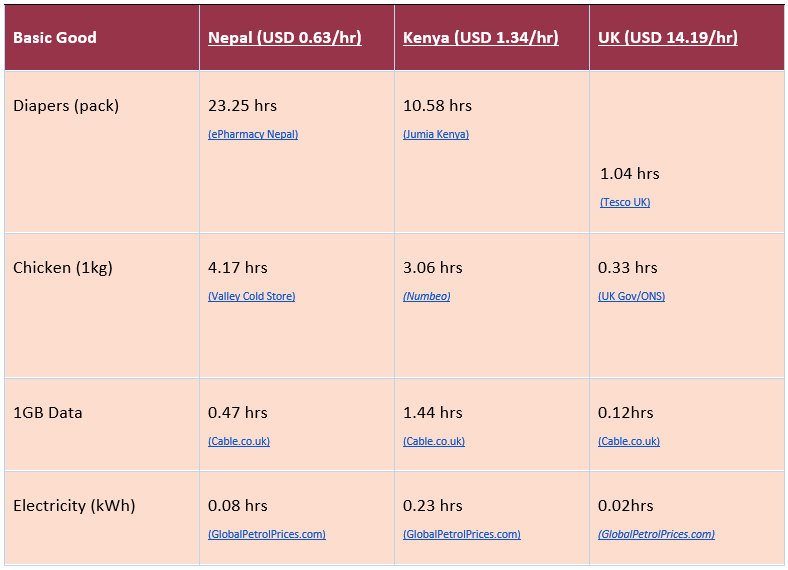
The debate made me ponder on what the opportunity cost would be, it made me run the numbers last month. A simple calculation ended the debate and the dilemma: In London, a jumbo pack of Pampers diapers costs me 1.04 hours of work at minimum wage. In Kathmandu, the same pack costs 23.25 hours of work at minimum wage.
I suddenly realized, this is not a mere price gap but a life gap. And how I would easily miss dozens of sunrises with my daughter just to keep her clean.
Brutal Arithmetic
We often talk about affordability in terms of currency. But what if we measured it in time?
Table 1 shows what it costs in work hours at average wages to afford the basics in Nepal, Kenya, and the UK:
Table 1. Cost of Everyday Items in Work Hours at Average Wages in Nepal, Kenya, and the UK
(Data captured May 2025)
In the table above, the cost of several basic goods is compared across three different countries: Nepal, Kenya, and the UK, with their respective average hourly wages of USD 0.63, USD 1.34, and USD 14.19. The table shows how many hours a person would need to work to afford one of each item. In simple terms, the time cost to acquire the basics is proportional to the cost of living or simply purchasing power parity.
A Mother’s Heartbreaking Calculus
My wife’s cousin in Kathmandu, a mother to an 8-month-old, once confessed: “My husband works at a bank. Together, we earn around USD 263 per month. After rent and rice, we can’t afford diapers. I’m applying for a job in Saudi Arabia — not for dreams, but because I can’t watch my son sit in soiled diapers.”
Her voice cracked as she admitted she might miss his first steps. This isn’t migration by choice — it’s surrender to a rigged system.
What Makes a Country Rich?
When you measure basics by hours of life spent earning them instead of money, some things are hard to unsee. The average Kenyan pays 26% of their hourly wage per unit of electricity, versus 0.13% in the UK. Nepal’s 28-minute-per-GB mobile data cost is a hidden toll of the country’s monopoly and weak infrastructure.
In Kathmandu, it takes three 8-hour workdays to afford a single pack of diapers.
Six Systemic Failures Driving Time Tax Inequities
- Wage apartheid: The hourly wage in the UK (USD 14.19) versus Nepal (USD 0.63) is just one example — the world is not a meritocracy, but a geographic lottery.
- Global prices, local wages: Multinationals price diapers similarly worldwide, even though earning power varies wildly.
- Import penalties: Nepal’s 30% tariff on diapers adds six extra labor hours to each pack.
- Flat pricing, unequal Impact: Basics like electricity cost nearly the same across the world but absorb many more work hours in poorer countries.
- Broken markets: In Kenya, Safaricom’s market dominance means 1GB of data costs 1.5 hours of work.
- Inflation’s bite: Nepal’s 7% inflation rate last year, as per the World Bank, meant more time spent earning the same goods.
Time Tax as a More Impactful GDP Alternative
Three shifts could meaningfully reduce the time tax:
Time Tax Reporting: National government and international institutions should track how many hours are required to afford the basics, alongside GDP and inflation figures. This index would highlight inequality in human time, not just income.
Time-conditioned Development Support: The International Monetary Fund (IMF), World Bank, and bilateral development agencies should move beyond tariff reform. They must invest in local innovation, supporting small manufacturers and cooperatives in low-income countries to produce diapers and other basic goods at affordable costs using locally available materials.
Whether through grants, concessional loans, or capacity-building aid, the goal should be to reduce the time tax through sustainable, decentralized production — building dignity, not dependence.
National time targets: Countries should aim to cut the time tax for their citizens, not only for food, energy, and hygiene, but also for quality healthcare, education, and housing.
When time becomes the benchmark, policy priorities shift toward dignity and wellbeing rather than output alone.
A Father’s Plea
Like many Nepalis raising their children abroad, I want my daughter to grow up hearing her grandmother’s lullabies, not just where my salary stretches the furthest. But until an hour’s work in Kathmandu buys what it does in London, returning home often means choosing between family proximity and economic dignity.
The time tax clearly explains why.
If Nepal and other countries like it are to retain their people, development must be measured not only in rupees or dollars but in time reclaimed for living.

Saurav Sharma is a digital marketing professional based in London and a former researcher at the Samriddhi Foundation. Writing at Saurav Insight, he acts as a scout connecting micro-experiences to the bigger picture of political economy. He is a father, and this article reflects his personal experience.