Nepali workers abroad sent home USD 13.26 billion in the first ten months of FY 2025/26 alone. Yet the economy they left behind saved less than ten cents of every dollar it produced. How does a country take in this much and end up no closer to escaping poverty? Nepal’s governance failures are not confined to one sector. Remittances, public debt, and a large informal economy are modern versions of a problem economists described seventy years ago. Each brings money into the economy, and each ends with that money spent instead of invested.
The Vicious Circle of Poverty
In 1953, economist Ragnar Nurkse described the vicious circle of poverty: low income leaves little room for saving, low saving limits capital formation, low capital per worker keeps productivity low, and low productivity reproduces low income. A few years later, economist Richard Nelson made a related argument, the low-level equilibrium trap. Near subsistence, people cannot save enough to push the capital stock past the point where growth becomes self-sustaining.
The harder question was how a country gets out of that circle. Nurkse’s answer, echoed by post-war economists, was an outside injection of investment, usually from abroad, since domestic saving was too thin to do it alone. Later economists, including Michael Todaro and Stephen Smith, argued that the injection has to be structural. It has to move labor into higher-productivity work, backed by real investment in education, health, and technology.
Not every inflow counts as that kind of injection. When a developing country receives or borrows capital and spends it on consumption instead of productivity, the circle stays intact. It just becomes more comfortable to live in. Three symptoms show how Nepal has become entrenched in this poverty trap: remittance dependency, public debt, and an informal economy the state cannot tax.
Symptom One: Remittance Dependency
Nepal’s migration economy took shape after 1990, when liberalization opened Gulf and Malaysian labor markets to Nepali workers. Outflows of workers and remittances accelerated sharply between 2003 and 2010, as Nepal began building its economy around labor export instead of agriculture or industry.
Most of that money went to consumption, not investment. Gross domestic savings, income generated within the country minus what it consumes, stood at just 9.71% of GDP in 2025/26, according to Nepal Rastra Bank. Gross national savings, which includes money earned abroad, was 44.77%. That thirty-five-point gap is remittances, income that nothing Nepal makes or sells has generated. Of the remittances flowing in, only an estimated 2-3% of remittances has gone into capital formation, while roughly 80% has been spent on everyday consumption. Much of what households buy is imported, so the money leaks back out, widening the trade deficit and undercutting domestic tradable goods.
Two decades after that acceleration began, the dependency hasn’t eased. NRB data show remittance inflows rising 41.2% in rupee terms and 33% in dollar terms during the first ten months of FY 2025/26. Growth still depends on exporting workers, not on what farms and firms at home produce. Remittances are only one place the trap shows up. Public debt is another.
Symptom Two: Public Debt
Debt only makes sense next to the economy carrying it. Nepal’s GDP is projected at roughly USD 45.8 billion for 2026, with per capita income of about USD 1,658, far below the world average of roughly USD 14,554. That is the base the debt has to be serviced from.
Total public debt reached about NPR 2.96 to NPR 2.97 trillion (roughly USD 19.2-19.3 billion) by mid-2026, according to the Public Debt Management Office (PDMO). That is a debt-to-GDP ratio of about 45%, up from 25% in mid-2015 and 30% by mid-2018. The PDMO acknowledges that over half of the recent increase came from currency depreciation, not new borrowing, and that a growing share of new debt goes toward repaying old debt and recurring expenses, not projects that earn a return. On Nelson’s curve, debt that finances debt adds nothing to tomorrow’s income, so the economy stays on the trap side.
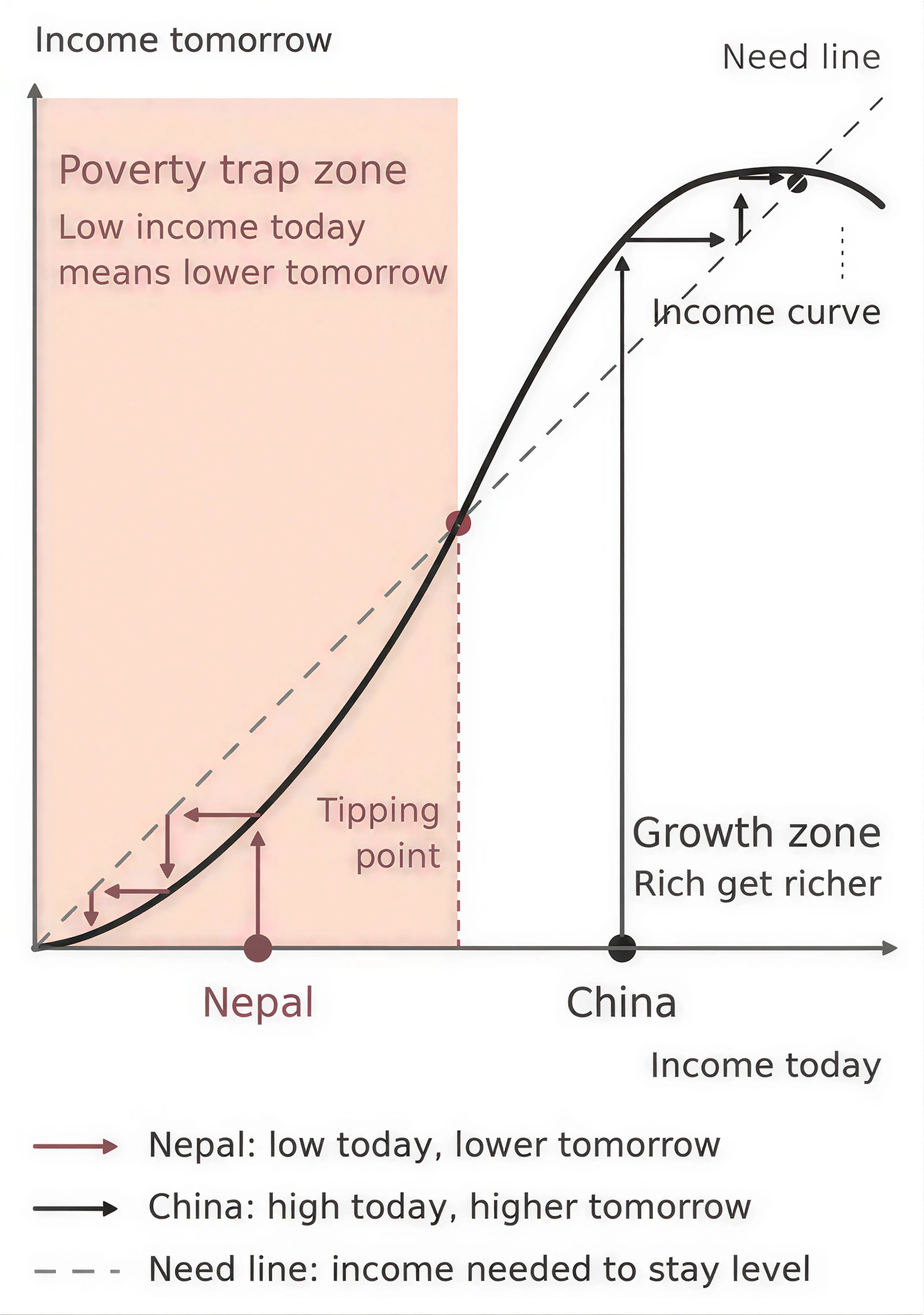
Fig.: Why poor countries get stuck (Nelson’s low-level equilibrium curve).
Think of the figure as a simple question: given what a country earns today, what will it earn tomorrow? The figure compares what a country earns today with what it earns tomorrow. The dashed line is the country’s need, the income it must have just to sustain itself, and the black curve is the income it actually ends up with. Where the curve sits below the need line, income falls short and slips backward. Where it sits above, income exceeds need and grows. The tipping point is where the two crosses.
Nepal sits left of that point. Its income is too low to cover what it spends each year on salaries, food, fuel and interest, so it borrows to fill the gap. That money goes mostly to consumption and old debt, not to roads, factories or schools, so it adds no new income. Interest and inflation then push needs up while income stays flat, so next year’s gap is bigger and more borrowing follows. China sits on the other side, where income exceeds need and the surplus is invested, so tomorrow’s income is higher. The figure is the same cycle described earlier, drawn as a graph, and both remittances and borrowing feed it.
Size alone does not explain the trap. Japan’s debt-to-GDP ratio stands at 204.4% under the IMF’s April 2026 World Economic Outlook, and it is often cited to argue that a high ratio isn’t automatically dangerous. It depends on what the debt finances. Nepal’s 45% is modest by comparison, but composition, not size, is the real concern. Debt that finances consumption, rolls over old obligations, or grows through currency losses builds no capacity to repay itself, leaving the country exposed if growth or export earnings slow. Debt is only half of the fiscal picture. The other half is how much revenue the state manages to collect.
Symptom Three: The Shadow Economy the State Can’t Tax
Nepal doesn’t lack tax laws. Its tax-to-GDP ratio has historically been the highest in South Asia, ahead of India’s, and it is among the few in the region not underperforming its revenue potential. The problem is that a large share of the economy sits outside any tax system’s reach. The Ministry of Finance estimates 43% of Nepal’s market operates informally, likely more in practice. Roughly 70% of transactions happen without an invoice, and over 40% of imports move through Hundi, an informal channel that never touches a bank record. A former Joint Secretary who tried to enforce invoicing rules at the Department of Commerce put it bluntly: traders resist billing not because compliance is hard, but because the untaxed margin is the real profit. No receipt means no tax record.
The consequence shows up in the government’s own books. In FY 2025/26, total expenditure reached NPR 1,582.17 billion against revenue of NPR 1,241.32 billion, a fiscal deficit of roughly 1.7% of GDP. Tax revenue can’t close the gap, not because rates are too low, but because so much activity never reaches a taxable transaction. Borrowing fills what collection can’t.
The failure to collect and the failure to invest are connected. A state whose revenue falls short has to borrow, and borrowing without building compounds the debt. In a largely informal economy, remittances and borrowed money alike dissolve into consumption, because so little passes through a channel the state can see.
Three Symptoms of One Trap
Put side by side, these are not three problems but one, showing up in three places. Money earned abroad, borrowed against future taxpayers, or never collected from current ones ends up spent, not converted into productive capacity. Remittances raise consumption but finance imports, not factories. Debt finances recurring spending, not infrastructure. An economy that stays largely informal starves the state of the revenue it needs for the education and health systems that would raise productivity. None of these flows raise domestic savings, expand what Nepal can produce and sell, or break the cycle Nurkse described: low income to low saving to low investment to low productivity, and back to low income.
The Open Question
Nepal is not short of inflow or of fiscal capacity on paper. It is receiving an unprecedented remittance surge, carrying a debt ratio most economies would consider manageable, and collecting tax at a rate that already outperforms its regional peers. What it lacks is the institutional capacity to convert those advantages into productivity: an economy formal enough to tax, an education system that builds real skills, and a state that borrows to build rather than to get by. Whether Nepal’s institutions can make that shift, or whether each new inflow simply refinances the same consumption and resets the same trap, is a question the next few fiscal years will answer. So far, the arithmetic of the last two decades has been answering it for them.

Shubham is a BBA (Honors) Finance student at Kathmandu University School of Management. His interests lie at the intersection of development finance, economics, financial markets, and applied research. He is particularly interested in evidence-based economic policy, sustainable development, corporate governance, and the role of financial systems in fostering inclusive economic growth.