A year ago today, on September 8, 2025, Nepal went through an uprising that changed the country forever. This year, the government made that anniversary official, declaring September 8 a public holiday, remembering the lives lost during the protest. We take this moment to remember the lives that were sacrificed, and to think of the families who lost their loved ones.
That day, the morning felt deceptively normal. There were videos of young protestors singing and dancing on the streets. At the Nepal Economic Forum, we were on the other side of the Kathmandu valley, deep in a meeting with a partner organization, working on a proposal. By early afternoon, the mood in our feeds had turned. The playful clips gave way to footage of police firing on crowds, then word of the first casualty. Among the videos that spread was one of a backpack-wearing schoolchild shot by police, a moment that would come to define the day’s horror for many of us. What had started as a peaceful protest ended with nineteen confirmed deaths by evening. In the new chapter I have added to Nepal 2043 – Road to Prosperity, updated to record what happened that week, I call this day Black Monday.
What followed was Inferno Tuesday, less a protest by then than a nationwide reckoning with years of pent-up anger. Politicians were dragged from their home and beaten, the footage spreading instantly online. Parliament and Singha Durbar burned. Mobs moved through the country targeting the properties of politicians and businesspeople, and, regrettably, ordinary citizens too; we sympathize with everyone whose home or livelihood was destroyed in the chaos that followed. In the hours after, more lives were lost, more property was destroyed, and the disorder spilled into politics, prisons, markets and the public mood.
I had been due to launch my book around that time. We postponed it, since uncertainty had become the only constant. But as the year unfolded, that same upheaval opened the door to changes few of us would have predicted. Snap elections delivered a historic parliamentary majority to a new party. The country got its youngest-ever Prime Minister, Balendra Shah. And Finance Minister Swarnim Wagle stood in Parliament to deliver what one newspaper called the boldest economic reform budget since 1991, doubling the income tax threshold and committing USD 13.8 billion to infrastructure, technology, health and education.
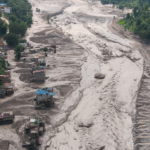
Just short of a year after that upheaval, Nepal was tested again. On August 26, an ice-rock avalanche near the Nepal-Tibet border tore into the Bhotekoshi and Trishuli rivers, sending a flash flood through Rasuwa, Nuwakot, Dhading and neighboring districts. As of this week, Nepal Police have confirmed more than 1,350 deaths, with thousands more still unaccounted for. Roads, bridges, hydropower plants and entire settlements were wiped out. The government declared September 7 a National Day of Mourning for the flood’s victims. It falls the day before Gen-Z Martyrs’ Day. This week, Nepal is mourning two tragedies, a year apart, back-to-back.
Nepal never seems to catch a break.
And yet, within days of Inferno Tuesday, we watched a familiar pattern play out again. I drove out during a lull in the curfew and stopped to talk to a traffic police officer at the Battisputali crossing; his own station had been burned down, but a nearby household was giving him water and letting him use their bathroom. Across the city, people came out to clear debris, help police stations get back on their feet, and track down stolen goods so they could be returned. It was the same instinct I write about in Chapter 4 of Nepal 2043, Thriving in Chaos: Nepalis pulling through disaster after disaster, from the Gorkha earthquake to Covid-19, sustained less by the state than by community bonds like the Guthi trusts, and by neighbors who simply show up.
But that same chapter insists resilience among citizens cannot substitute for capable institutions. The ability of Nepalis to thrive in chaos does not mean the government gets to hide behind. There needs to be a constitutional clarity on who is in charge during a disaster, a functioning emergency response system, clean procurement protocols so crises don’t become opportunities for profiteering, and, above all, a shift in mindset from control to facilitation.
This time, some of that appears to be landing. Rather than the scattered, often opaque fundraising that has followed past Nepali disasters, the government centralized relief into the Prime Minister’s Disaster Relief Fund, which had collected more than NPR 7 billion by early September. Authorities moved quickly to shut down freelance social media fundraising drives and insisted contributions go through the official fund alone, a small but telling gesture toward the discipline the book had called for. Thousands of security personnel, officials and volunteers have worked around the clock, and Nepal’s international goodwill has again opened doors, with governments and multilateral agencies stepping in with aid.
Regardless of any crisis, political or natural, Nepal and the Nepali people have always come out thriving, and we at NEF are confident that this time, too, Nepal will recover stronger. Economic recovery is always easier than emotional recovery, and this year has asked for plenty of both. The blood on Kathmandu’s streets dried up months ago, but the scars have not, and now Rasuwa, Nuwakot and Dhading carry scars of their own. What Nepal does with the sacrifices of the last year, and the grief of the last two weeks, will decide how much closer the country really is to the Nepal that 2043 imagines. The full account, Black Monday, Inferno Tuesday, and everything that has followed since, is in the new chapter of Nepal 2043, A Year That Felt Like a Decade.
Sujeev is the founder CEO of beed. He leverages over 25 years of experience in diverse fields and geographies to advise, lead and inspire. With comprehensive networks in Nepal’s public, private, civil and diplomatic sectors, Sujeev is a trusted business and policy advisor and respected strategic thinker. From economies of developing countries to economies of human beings, he moves across different worlds, with his passion for the Himalayas being the axis.