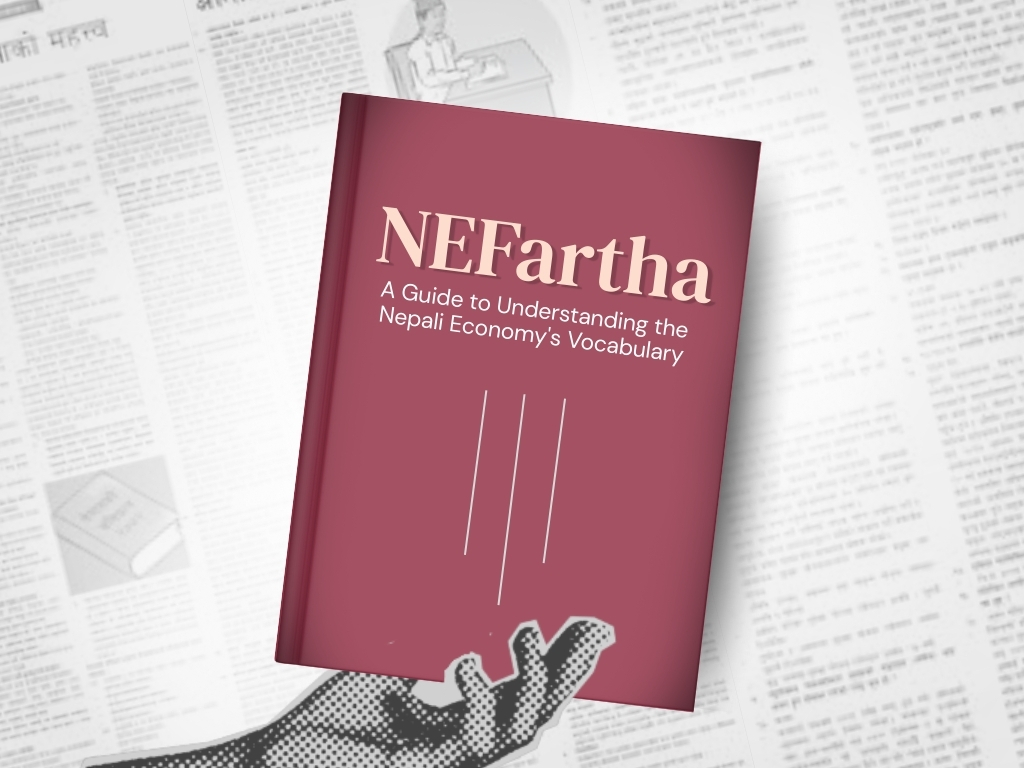
NEFartha is a dictionary that explains the unique terminology of the Nepali economy in a simple and accessible way. Given Nepal’s distinctive traditions and culture, NEFartha is for students, researchers, policymakers, or anyone curious about how Nepal’s economy works.
Land tenure and sharecropping system
Adhiya is a traditional form of land tenure, widely practiced in Nepal. The tenant normally shares at least 50% of the crop with the landlord. While the landlord keeps at least 50% of what is produced, the tenant has to provide labor and cover every aspect of production costs, including the cost of land improvements and agricultural inputs.
A form of mortgage
Bandhaki is a piece of land given as collateral for a loan. Until the borrower repays the loan, the moneylender cultivates the land and keeps all the produce, without sharing it with the landowner. If the borrower fails to repay the debt within the agreed time, the moneylender transfers the ownership of the land to his own name.
A kind of sycophancy
Chakari is a traditional Nepali social system where people form loyalty-based relationships with more powerful individuals to gain access to resources, opportunities, and protection that formal institutions fail to provide.
A rotating savings and credit association
Dhukuti is a rotating savings and credit association (ROSCA) in which participants contribute fixed amounts at regular intervals, with the accumulated fund disbursed to one member per cycle. The allocation sequence is primarily determined through a sealed-bid auction system, where the fund is awarded to the lowest bidder.
Monopoly
Ekadhikar is a market structure where a single person or company has exclusive control over the supply of a particular good or service.
A form of land endowment
Guthi is a traditional Nepali socio-economic institution that functions as the country’s first land pooling system, where communities collectively cultivate endowed land to generate revenue for religious and public services. The income from these land assets is used to maintain temples, public shelters, water sprouts, organize religious festivals and performance art, while also providing fellowships for various arts and professions.
Weekly rural open-air market
Haat Bazaar is an open-air, temporary market that takes place on a regular basis (usually once or twice a week) in rural and semi-urban areas of Nepal.
Fuel
Indhan is any material that can be burned or used to produce energy. It includes coal, wood, petrol, oil, or gas that provide energy for cooking, heating, transport, or operating machinery.
Climate Finance
Jalbayu Bitta is funds from governments, businesses, and other sources that support projects aimed at both reducing greenhouse gas emissions and helping communities adapt to the impacts of climate change.
A system of communal land tenure
Kipat is a communal land tenure system, practiced mainly by the Limbu community in eastern Nepal. The land was collectively held and inherited within ethnic groups and could not be sold outside the community. It was abolished in the 1960s.
Nepalis recruited into the British and Indian armies
Laure originated during the reign of King Ranjit Singh of Lahore, when young recruits serving as soldiers were popularly called laure. In Nepali society, the term later came to broadly denote youths who join foreign military forces, such as those of India, Singapore, and Britain.
Monetary Policy
Maudrik Niti are the set of actions and decisions by a country’s central bank to control the supply and cost of money in the economy, aiming to maintain price stability and overall economic balance. It includes regulating interest rates, credit flow, and liquidity to manage inflation and influence economic activity.
Policy Rate
Nitigat Dar is the interest rate set by a country’s central bank that guides commercial banks in lending and borrowing. It is a key tool of monetary policy used to influence money supply, control inflation, and stabilize the economy.
Five principles of peaceful co-existence
Panchasheel is the set of principles that Nepal’s foreign policy is based on. It consists of mutual respect for territorial integrity and sovereignty, mutual non-aggression, mutual non-interference in internal affairs, equality and mutual benefit, and peaceful coexistence. This doctrine was first formulated in 1954 and subsequently adopted by Nepal in 1955.
Government revenue or state income
Raajaswa refers to the total revenue collected by the government within a fiscal year from all sources, including both tax revenues (direct and indirect taxes) and non-tax revenues (such as fees, fines, royalties, and dividends).
Cooperative
Sahakari are member-owned and democratically controlled organizations. It raises funds through membership shares, savings, loans, and grants, which are used for loans to members, operations, and investments. Cooperatives are recognized as a legal entity under the Cooperative Act, 2074.
Liquidity
Taralata refers to the ease and speed with which an asset or investment can be converted into cash without significantly affecting its price. In banking terminology, it denotes the level of cash availability maintained by financial institutions.
Productivity
Productivity is the measure of how efficiently inputs like labor, time, or capital are used to produce goods or services.
Exchange Rate
The value at which one country’s currency is exchanged for another country’s currency, determined by market conditions or official policy.
Balance Sheet
Waslat is a financial statement that summarizes a company’s or organization’s assets, liabilities, and equity at a specific point in time.
Feudal-like landholder
Zamindar is a class of landowners based in the eastern Tarai and Baisi regions, entrusted with the responsibility of extracting revenue from peasants in the villages under their jurisdiction.