
The Rastriya Swatantra Party (RSP)’s landslide victory in Nepal’s March 2026 elections marks a turning point in the country’s political landscape and economic trajectory. Emerging as a force defined by its opposition to entrenched establishment politics, the RSP tactfully captured public appetite for change and disruption. Nepal stands at a critical juncture, with the choices made now likely to shape its political and economic trajectory for years to come.
The party is inheriting a difficult set of structural conditions and has a large task ahead in terms of reforming governance, tackling corruption head-on, and growing the economy in a strategic and equitable way. Much of Nepal’s growth over past decades has been remittance-driven; the central challenge now lies in transforming these foreign earnings into productive investments that spur industrial diversification, structural reform, employment generation for the country’s youthful population, and equitable access to opportunities. In particular, Nepal’s upcoming ‘graduation’ from the United Nation’s Least Developed Country category to a lower-middle-income economy introduces a shift in Nepal’s economic strategy in which trade and service-export will have to take center stage, in the context of declining foreign aid and, particularly now in the context of intensifying conflict in West Asia and global economic uncertainty, diversifying beyond remittances.
On March 28, the party released a 100 day work plan outlining the next steps for their political goals. To get a better understanding of RSP’s vision, we must deeply examine the RSP 2026 manifesto, released just a month prior on February 19. Much of the agenda in the manifesto is rooted in the demands of the Gen Z movement, whose frustrations over nepotism, corruption, and the traditional governance system contributed to the dissolution of parliament and the subsequent election. This “citizen contract” serves as a pivotal vision document, an ambitious blueprint that underscores the party’s market-oriented reform agenda. Structured around 100 policy commitments, it lays out RSP’s aspirations for governance, economic growth, and institutional renewal. A significant amount of the manifesto is based on the High Level Economic Reform Commission report of April 2025, existing public research, and industry-inputs. Of course, a manifesto is merely a visionary document that serves to guide the party’s further action and policy ideas and cannot be read as a definitive document. Rather we should see the manifesto as a living document to engage with, critically inquire, and develop collaborative strategies to support Nepal’s economic and governance reform agenda.
This NEFTake unpacks the manifesto’s central themes, critically assessing its strengths, biases, and blind spots to reveal what they suggest about the party’s broader vision for Nepal’s future.
Governance and Institutional Reforms
At its core, the manifesto laid out by the RSP envisions a significant transformation in governance and economic reform for Nepal, particularly making bureaucratic simplification a recurring priority. Central to this effort is digitization, with plans including expanded digital public service delivery, one-stop service centers across government departments, paperless administration, and the institutionalization of digital signatures. Additionally, the manifesto builds on existing government efforts to extend the use of national identity cards and consolidate public services through integrated platforms like the Nagarik App.
These administrative reforms are underpinned by a broader anti-corruption agenda. In the manifesto, the RSP commits to acting on the findings of the judicial inquiry commission formed to investigate the use of force during the Gen Z protests. Beyond this, the manifesto proposes mandatory property investigations for public officials, the removal of unjustified allowances, and greater transparency in the judiciary. Meritocracy is also a stated priority, with plans to eliminate partisan influence from government bodies and trade unions alike. In the economic sphere, the manifesto pledges to dismantle cartels, curb rent-seeking behavior, and address unfair competition in sectors such as transportation. Rounding out this agenda, the RSP also turns its attention inward, introducing measures to regulate internal party governance and bring greater order to Nepal’s broader political environment.
Through these measures, the RSP signals an ambition to redefine the nature of Nepali politics itself, shifting it away from patronage and procedural inefficiency toward a more streamlined, technocratic, and results-oriented model of governance.
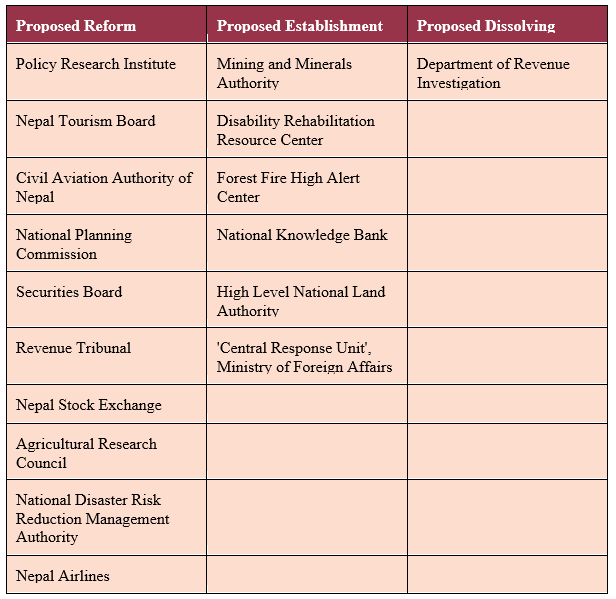
As seen in Table 1, RSP also envisions, as laid out in their document, reforming, dissolving, and creating new government bodies and institutions.
Table 1: Proposed Restructuring of Government Institutions
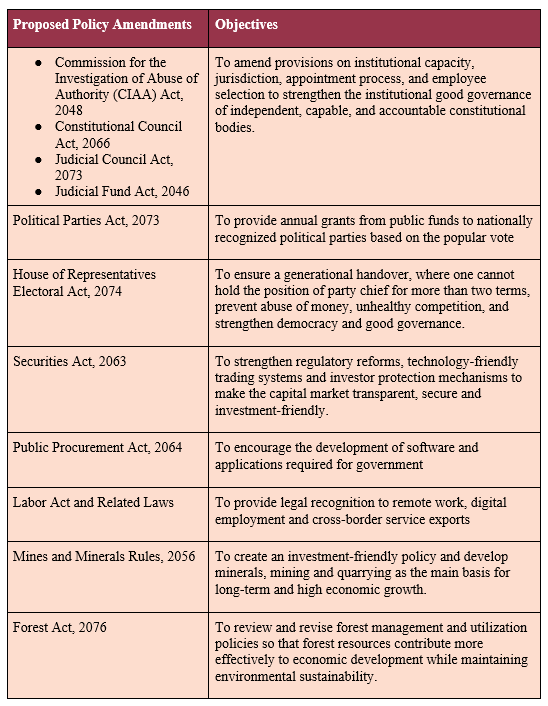
RSP also laid out several envisioned policy proposals and reforms in their manifesto. Tables 2 and 3 are derived from the manifesto. The tables include only those policies that the manifesto explicitly identifies as laws or measures it intends to introduce or amend; it does not cover the many broader or more general policy commitments.
Table 2: Proposed Policies
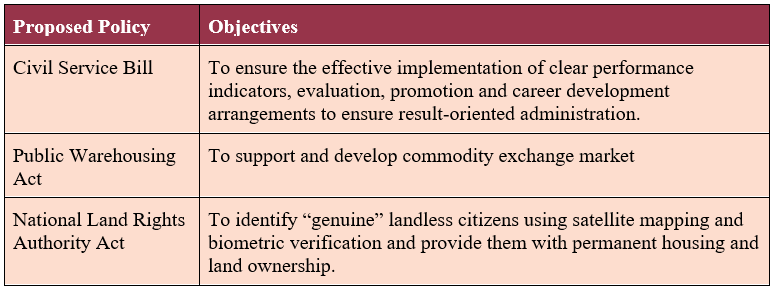
Table 3: Policy Amendments
Privatization and Economic Growth
The RSP has outlined an ambitious vision of transforming Nepal into a USD 100 billion economy within five to seven years, targeting an annual growth rate of 7% and a per capita income of USD 3,000. At the core of this vision is a strategy focused on increasing productivity, expanding high-value exports, and fostering the growth of the digital economy. Private sector development is also identified as the primary driver of economic growth, with the government repositioned as a regulator and facilitator. Accordingly, improving the ease of doing business emerges as a recurring theme, supported by plans to introduce investment-friendly policies, streamline administrative processes, and enable international payment gateways to better integrate domestic startups into the global market. Public–private partnerships are highlighted as a key reform priority, with proposals to restructure public enterprises, especially with energy and aviation, such as with plans to privatize Nepal Airlines.
Strengthening Domestic Industry
In parallel, the manifesto places strong emphasis on strengthening domestic industries, including agriculture, mining, and information technology, with the aim of moving Nepal up the value chain. Trade enhancement is also closely tied to this objective, particularly through the promotion of high-value exports and digitization of customs processes at border points.
The party also articulates an industrial policy centered on energy-intensive sectors such as mining, steel, cement, herbal processing, data server operations, and fertilizer production. Complementing this, the manifesto promotes greater domestic energy consumption through expanded use of wind and solar power by reducing restrictions on the use of natural and forest areas for infrastructure and hydropower development.
To support this industrial push, the party seeks to more actively commercialize land, forests, and environmental resources by streamlining procedures related to environmental impact assessments, land acquisition, and infrastructure development.
Betting on the Digital Economy
As aforementioned, the party prioritizes the digital economy, calling for investment in data centers, cybersecurity, and digitized public services to advance Nepal toward higher-value, export-oriented IT activities. It envisions this sector as a key source of jobs for young workers, with ambitions such as selling high-value server processing time and positioning IT as a leading export industry, goals that hinge on improved energy reliability, connectivity, and regulatory stability. Measures such as labor law reforms, easier cross-border payments, digital nomad provisions, and expanded access to global payment gateways are intended to improve conditions for digital work and investment. However, without parallel efforts to address structural bottlenecks, such as inadequate infrastructure, uneven digital literacy, and weak institutional capacity, these initiatives risk remaining more aspirational than transformative, potentially reinforcing rather than reducing existing inequalities in the digital economy.
Modernizing Agriculture
The manifesto presents agriculture as a core priority for meeting production, trade, and food security goals. It proposes a wide toolkit, such as subsidies, import substitution, value-added agro-industries, business facilitation, the use of FinTech and Agritech, and agricultural insurance, that could, if carefully designed, help make farming more commercially viable and resilient. Taken together, RSP’s proposals point toward a more market-oriented and technologically integrated agricultural system. The party also advances a land use reform agenda in which forests are opened up to broader economic uses, including livestock farming and infrastructure development, alongside incentives for bringing barren land into more consolidated and productive use. How these reforms are interpreted and implemented on the ground will be an important development to watch, particularly in terms of how the party reconciles its production-oriented goals with the need to safeguard ecosystems, prevent deforestation, and align agricultural growth with Nepal’s environmental and climate commitments.
Boosting Tourism
In tourism, the RSP sets out an optimistic agenda of doubling tourist arrivals and per capita spending, while extending average length of stay within five years, reflecting confidence in tourism as a potential driver of growth and foreign exchange. Proposals to reform the Nepal Tourism Board for more creative marketing and to diversify destinations toward Karnali, Sudurpaschim, Madhesh, and Koshi indicate an effort to spread benefits more widely across the country and to showcase Nepal’s geographical and cultural diversity. This also includes implementing the existing “Hill Station Development Policy” to better develop the hilly areas near Nepal’s southern border to attract tourists. The focus on improved mountain tourism management and the promotion of cultural heritage, particularly in places like Janakpur, suggests an emerging sensitivity to sustainability and cultural value, even as the details of product development, infrastructure, and local capacity-building will need to be worked out over time.
Investing in Public Infrastructure
A clear cross-cutting priority to support the aforementioned economic growth agenda is a large-scale investment in industrial and public infrastructure as a driver of economic transformation. Over the next several years, the party aims to fast-track stalled national pride projects and introduce ten new, sector-diversified initiatives, including an international sports city, higher education research center, specialized healthcare facilities, and cultural tourism infrastructure. The document calls for a fundamental shift in how projects are executed, anchored in fixed timelines, budgets, and dedicated teams. The manifesto also emphasizes enhancing physical connectivity through highway expansion, airport modernization, and the development of both cross-border and domestic railways, such as the Mechi–Mahakali electric line and links to India and China. This links to a broader agenda on improving public transportation and road safety. Many of the policy ideas aim to also integrate digital technologies such as the use of drones and satellite technology for managing forest fires or AI-based traffic cameras and GPS tracking of public vehicles.
Strengthening the Financial Sector
The manifesto also outlines a series of reforms aimed at strengthening Nepal’s financial sector. It calls for tighter oversight of financial regulators and amendments to the Securities Act, along with efforts to improve overall regulatory capacity and align it with international standards. As part of this, non-bank financial institutions (non-BFIs) with transactions exceeding NPR 500 million would be brought under the supervision of Nepal Rastra Bank and required to meet standards equivalent to Class D institutions. At the same time, a high-powered second-tier regulator is envisioned to oversee the managed operation of smaller institutions. The manifesto also proposes reforms to deepen and modernize capital markets, including restructuring the IPO system and introducing instruments such as intraday trading, short selling, and derivatives like futures and options. It also signals a cautious openness to emerging technologies, proposing a tightly regulated pilot for crypto mining in the first year, alongside plans to develop a regulatory framework for cryptocurrencies based on global best practices to strengthen investor protection. The manifesto further aims to channel credit toward productive sectors and reduce distortions such as excessive interest burdens. Overall, these reforms are aimed at building a more transparent and diversified financial system.
Strengthening Ties with the Global Nepali Community
The RSP also recognizes the Nepali diasporas’ emotional and economic ties to Nepal, and positions them as key partners in driving long-term transformation. There is also an emphasis on opening Nepal’s financial markets further to non-resident Nepalis, making participation more accessible and meaningful. The manifesto also aims to better utilize diaspora expertise through a proposed “National Knowledge Bank,” linking global skills and knowledge with sectors like education, health, and industry in Nepal. To strengthen this connection, the party proposes granting voting rights to Nepalis overseas and expresses support for dual citizenship. The RSP also plans to launch Digital Consular Services for online passport renewal and document verification, ending embassy queues, and to establish a 24/7 Central Response Unit with Rapid Teams in each mission for on-site support and rescue. It also aims to encourage diaspora driven investment, through stronger legal protections, simpler use of dollar accounts, smooth repatriation of returns, and fewer bureaucratic hurdles around property ownership. At a broader level, the RSP envisions global Nepali communities as natural ambassadors, helping promote Nepal’s culture, tourism, and opportunities, and quietly strengthening its global presence.
Foreign Policy and Diplomacy
RSP’s manifesto also recasts foreign policy as a driver of economic transformation, emphasizing cross-border energy trade, investment attraction, and the goal of establishing Nepal as a reliable regional power supplier. It advances a “balanced and dynamic diplomacy” that seeks to turn Nepal’s position between India and China into trilateral economic partnerships and connectivity, while selectively learning from each neighbor’s development strategies. The party also proposes to professionalize Nepal’s missions abroad through performance audits, an expanded cadre of economic counselors, and a stronger focus on exports, tourism, investment promotion, and climate finance mobilization.
Integrating Economic Liberalization with Social Investment
The majority of the manifesto envisions a modern, market-oriented, industrial, and digital Nepal, positioned as the engine of growth, job creation, and broader welfare gains. At the same time, the document articulates a parallel commitment to advancing human development. The RSP must carefully straddle the dual demands of sustaining economic expansion while ensuring that human development is addressed comprehensively and not treated as an afterthought. The party appears to seek a balance between two foundations: a liberal economic policy that empowers the private sector and mechanisms for equitable redistribution through public investment in education, healthcare, transportation, housing, and social security.
In healthcare, the party prioritizes expanding service coverage, particularly in rural areas, while reinforcing the national Health Insurance scheme to reduce financial barriers. The party also commits to establishing a State-of-the-Art Specialized Disability Rehabilitation Resource Center in each province and implementing an Early Identification and Early Intervention system to detect neuro-developmental disorders in children, complemented by initiatives like a Burn Treatment Fund, nationwide mental health services, and a 24/7 helpline.
In education, the RSP pledges sustained investment in the public system over two decades, tighter regulation of private institutions, and inclusive education through at least one specialized school for children with disabilities per province, while emphasizing teacher capacity-building, higher education transparency, research productivity, and positioning Nepal as an emerging international higher education hub.
On the social welfare front, RSP has laid out a shift away from Nepal’s current universally applicable social security entitlements towards a more targeted needs-based social security system. They pledge redesigning the social security system by creating a database to facilitate this process, particularly to reduce double benefits and potential misuse. How such criteria of deservingness are determined and how this will be implemented in practice as well as how civil society stakeholders will respond and engage on this matter will be an interesting development to keep an eye on.
Toward Better Governance of Labor Migration
Foreign employment remains a defining feature of Nepal’s economy, with a growing share of young people seeking opportunities abroad. The RSP’s manifesto acknowledges this reality by proposing stronger regulation of recruitment or “manpower” agencies to curb fraud and exploitation, concessional loans for marginalized groups to finance migration, and targeted support for returnees through subsidies, market access, and technical assistance to foster entrepreneurship. It also envisions an ID system for returnees to access selected government services at concessional rates. Taken together, these measures signal an effort to better govern Nepal’s migration system while integrating migrants and returnees into national development. Implicit within the RSP’s broader economic reform agenda is the expectation that as domestic opportunities expand, reliance on foreign employment will gradually decline.
Balancing Ambition with Inclusivity and Feasible Reform: Strengths, Gaps, and Biases
In our reading, the manifesto’s main strength lies in its ambitious approach to governance reform, anchored in commitments to build comprehensive digital public infrastructure, curb corruption, streamline institutions, and modernize policymaking. The party’s vision for enhancing the ease of doing business and fostering private sector growth is similarly well articulated. It presents an encouraging roadmap for infrastructure investment, improved physical and digital connectivity, and expansion of the digital economy. Equally notable is the RSP’s diaspora-inclusive agenda, which seeks to strengthen political participation, attract foreign investment, and promote Nepal’s cultural presence abroad. As Nepal graduates to lower-middle-income status this year, the RSP’s vision extends beyond the legacy of a “Least Developed Country,” emphasizing not only economic progress but also a fundamental shift in mindset, toward innovation, self-reliance, and a confident presence on the global stage.
The manifesto also reveals several biases and blind spots that merit closer examination. Most notably, it articulates a modern, market-oriented vision for Nepal with limited attention to foundational concerns such as wealth inequality, social inclusion, and discrimination. The document tends to privilege urban and middle-class communities, aligning with its broader ambition for growth and modernization. However, without a deliberate focus on socially marginalized groups, such growth risks deepening existing socio-economic divides. How will the party address issues related to wealth inequality throughout the country?
Furthermore, while the manifesto mentions a labor market reform program to address labor exploitation and fair wages, it lacks the clarity and detail present in other policy areas. What is envisioned and how will such a labor market reform plan be implemented? There is also a pervasive neglect of informal-sector workers and those in low- or semi-skilled occupations in the document. Given the large‑scale economic growth that RSP envisions, a central question is how this growth will translate into fairly compensated and secure jobs for Nepali citizens. The dominant assumption is that industrial expansion and sectoral growth automatically generate employment. Yet this is far from guaranteed. An urgent issue is also what kind of labor market institutions, regulations, and bargaining power will be necessary in Nepal to ensure that new jobs are not only created, but also dignified and well paid.
In terms of social welfare, the party’s emphasis on modernizing healthcare and education through specialized services for target groups appears promising and it will need to be complemented by a stronger focus on broad‑based inclusion and poverty alleviation at the foundational level. The manifesto’s proposal for a needs‑based social security system should also be approached with care, to ensure that those who depend on essential government allowances are not further marginalized. These will be important developments to follow closely.
Most concerningly, the manifesto is silent on issues of gender parity and justice; we found no explicit policy commitments related to gender, except for a proposal of female only buses. RSP, and the nation as a whole, would benefit from adding a gender lens streamlined into their policy proposals, particularly with respect to education, healthcare, financial access, and employment. With sexual violence and gender-based discrimination rampant in Nepal with little accountability, how can the government help create a safer environment for all girls and women in the country? Along with the party’s clear vision for Nepal’s economic growth and governance reform, Nepal needs dedicated policies which target these issues of social inclusion. With the inclusion of a notable number of women parliamentarians and party members, it is to be hoped that gender-responsive policies will find stronger expression in the party’s future agenda.
Furthermore, the manifesto’s strong market-oriented approach to economic development raises important questions about how environmental conservation and climate adaptation will be balanced with industrial expansion. As the party seeks to boost domestic energy consumption, open the mining sector, and promote energy-intensive industries, it positions the Ministry of Energy as a key driver of economic growth, likely elevating its political influence over the Ministry of Forests and Environment. This shift underscores a deeper institutional tension between economic priorities, adaptation to climate change, and ecological stewardship. How this balance is managed will be crucial, as Nepal’s development trajectory hinges on its ability to reconcile growth imperatives with the protection of fragile ecosystems and the pursuit of long-term environmental resilience rather than short-term economic gains alone.
Furthermore, certain tensions emerge within the manifesto itself. Many proposed policies lean heavily on technological solutions, which may face significant challenges in implementation and equitable access. While the party presents ambitious plans for large-scale infrastructure development, it simultaneously advocates tax reforms aimed at reducing the burden on the private sector. This juxtaposition raises a critical question: how does the party intend to finance and implement its ambitious agenda? In particular, how will bureaucratic streamlining, institutional reforms, and the digitization of public infrastructure be funded?
Toward Inclusive and Accountable Governance
Taken together, these strengths and shortcomings show that the RSP’s 2026 manifesto is a bold and economic growth-centered document, rich in ambition but uneven in inclusivity and leaving many questions open about strategic implementation. As such, it leaves open important questions for policymakers, researchers, and civil society about how these ideas will be put into practice and sustained through democratic accountability. For the private sector, this political moment represents massive potential for growth and more ambitiously taking center stage in Nepal’s growth trajectory. The manifesto’s many ambitious and, at times, contentious proposals also present valuable opportunities for constructive debate and engagement among the private sector, civil society, media, and research community in the months and years ahead. Given the RSP’s strong parliamentary majority, it is especially crucial that these discussions take place through open dialogue and genuine democratic deliberation. As Nepal stands at a political and economic crossroads, RSP is faced with a big task of balancing economic growth and governance reform with democratic deliberation, social equity and environmental stewardship. The RSP now has both the responsibility and the opportunity to translate its governance and economic reform agenda into action, building a system that is dynamic, inclusive, and firmly rooted in the people’s aspirations.