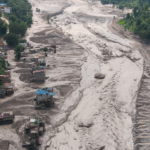
On the morning of 26 August 2026, a flash flood tore through the Bhotekoshi river, sweeping downstream through Rasuwa, Nuwakot, and Dhading causing both human and material damage. According to Nepal’s Department of Hydrology and Meteorology, the trigger was an avalanche of ice and rock that began on Nepali territory near the Lhende river headwaters, crossed into Tibet, and then slammed back into the river system on both sides of the border. Within days, the flood killed and displaced thousands of people and trapped workers inside a collapsed hydropower tunnel, pulling in Nepal Police, the Armed Police Force, and the Army alongside international rescue teams from India, China, South Korea, and Singapore.
This was not the first time Nepal has had to respond to a disaster at this scale. For disasters like this, Nepal has a set of systems built up over decades for how it responds: which office acts first, who coordinates everything, who makes the political calls, and how aid is meant to reach the people who need it. This piece walks through that system, then circles back to look at how it held up during the Bhotekoshi-Trishuli floods.
1. How the Response is Structured
The Legal Foundation
Every time a disaster strikes Nepal, how the country responds rests on the Disaster Risk Reduction and Management Act (DRRM), 2074 BS (2017 AD), the country’s core disaster law. It replaced an older Natural Calamity (Relief) Act, 2039 BS (1982 AD), and set up matching disaster management committees at every level of government, from the National Council, chaired by the Prime Minister, down to the Local Disaster Management Committee under each municipality. In between sit provincial committees chaired by the Chief Minister and district committees chaired by the Chief District Officer, one for each of Nepal’s 77 districts. Municipalities get their specific mandate from a separate Local Government Operation Act, and the whole arrangement is grounded in Schedules 6 through 9 of the constitution, which divide disaster powers across the three tiers of government
When a disaster strikes, the local government responds first, since it is closest to the disaster. If that is not enough, the district steps in, then the province, then the federal government, each escalation matches the committee structure above.
The Prime Minister’s Relief Funds
Disaster relief money moves through a separate track from the committee structure above. The PM Disaster Relief Fund sits under the Office of the Prime Minister, established by the Prime Minister’s Disaster Relief Fund Operation Regulations, 2063 BS (2006 AD), and donations to it carry an uncapped tax deduction under the Income Tax Act, well beyond what an ordinary charitable donation gets. The DRRM Act separately sets up a general Disaster Management Fund for routine spending at the central, district, and local levels, distinct from the PM’s public donation channel.
Two Thresholds for “Emergency”
Nepal has two very different thresholds for what counts as an emergency: a lower one used for nearly every disaster, and a much higher one reserved for genuine national crises. The lower, far more common bar is Section 32 of the DRRM Act, which lets the Council of Ministers declare a disaster-prone area by gazette notice, typically for three months and extendable. A total of 59 local levels across 18 districts were declared crisis zones this way after the 2024 floods. The much higher bar is Article 273 of the Constitution, letting the President declare a full state of emergency, but only for a grave threat to sovereignty, territorial integrity, or security, arising from war, foreign aggression, armed rebellion, severe economic disarray, natural disaster, or epidemic. It needs parliamentary approval within a month and is capped at three months. The two get confused often, but Nepal has never invoked Article 273 for a flood or earthquake, including in 2015. The lower, disaster-specific declaration does the practical work instead, and it is also what opens the door to requesting international assistance.
The One-door Policy
The one-door policy is a system that allows the Prime Minister’s Office to monitor and designate specific focal persons and locations for the collection of aid, which can then be distributed systematically by the government. This means that all disaster aid, whether money, food, clothing, or other goods, is meant to move through one official government channel. The legal root of this goes back to the Natural Calamity Act of 1982 AD, which gave the government the power to provide approval to groups rendering aid of any kind before entering a disaster-hit area, and set up committees to run relief through the state rather than through outside groups directly. The Act never actually spelled out a “one-door policy” by that name; it only supplied the legal base the policy was later built on. The policy as it’s known today took shape during the 2015 earthquake response, when the government tried to coordinate all relief through the District Disaster Relief Committees, and it was then formally adopted as government policy in August 2017, specifically because relief in 2015 had piled up in areas that were easy to reach by road while harder-to-reach communities went without. It has stayed in place since, carried forward through the DRRM Act, 2074 BS (2017 AD), and the National Disaster Response Framework, 2019.
With the legal and funding structure in place, the next question is who actually carries it out.
2. The Organizations Behind the System
NDRRMA
The National Disaster Risk Reduction and Management Authority, or NDRRMA, was created under the DRRM Act, 2074 BS (2017 AD), and became operational in December 2019, when its first executive chief was appointed. It is Nepal’s first agency built specifically for disaster coordination. Before it existed, that job sat directly with the Ministry of Home Affairs, operating under the 1982 law through a Central Disaster Relief Committee chaired by the Home Minister, with matching committees at the regional and district level.
NDRRMA’s mandate includes coordinating national policy, managing incoming international aid, signing agreements with private operators such as helicopter or drone suppliers, and organizing the response into clusters, each with a lead ministry and a supporting international agency. Emergency shelter falls to the Ministry of Urban Development with the The International Federation of Red Cross and Red Crescent Societies(IFRC )and UN-Habitat, health to the Ministry of Health and Population with the World Health Organization (WHO), water and sanitation to the Ministry of Water Supply with UNICEF, and so on.
National Emergency Operation Center
The National Emergency Operation Center (NEOC) is the central information hub which filters and disseminates updates to and from the impact area. The NEOC now falls under the NDRRMA but is nearly a decade older than the authority itself. The Ministry of Home Affairs opened it on 17 December 2010, as a standalone, earthquake-resistant building at Singha Durbar with its own backup power, built to run every hour of every day. Before NDRRMA was created, NEOC reported straight to the Ministry’s Disaster Preparedness and Response Section, doing essentially the same job it does now, and was simply absorbed into the new authority rather than rebuilt.
Every responder in the field is expected to route information back through NEOC. It initiates mobilization the moment a disaster hits and keeps every level of government working from the same picture in real time.
Nepal Police, the Armed Police Force, and the Nepal Army
Nepal Police, the Armed Police Force, and the Nepal Army, the country’s security forces together form an escalating chain on the ground during a disaster. Nepal Police, with the widest local presence, arrives first, handling light search and rescue and initial reconnaissance. If that is not enough, the Armed Police Force’s specialized teams step in, trained at a dedicated academy in Kurintar that has run for more than two decades in collapsed-structure search and rescue, swift water rescue, and rope rescue.
For the heaviest disasters, the Nepal Army takes over, bringing heavy machinery, mass medical teams, and heli-rescue capacity. Its constitutional role under Article 145 is national defense, so disaster relief is a secondary function, but it remains the country’s largest mobilization tool. In the 2015 earthquake, the Army deployed 90 percent of its total force in Operation Sankat Mochan, working jointly with the Indian Army.
The Prime Minister’s Office
Sitting above all of this is the Prime Minister’s Office, which handles the policy decisions, including whether to declare a disaster-hit area under Section 32 or, in extreme cases, recommend a full state of emergency under Article 273. During an active disaster, the Framework also routes the response through three additional, time-critical bodies that cut across the standing agencies: a Rapid Action Team out of the PMO, made up of officials with the political and security clearance to push past bureaucratic process, a Quick Action Team run by NDRRMA to pool the technical, logistical, and civilian resources needed, and a Joint Operation Committee under the Nepal Army to run tactical rescue missions directly in the impact zone.
With every piece of the system introduced, the real test is how it held up when a major disaster actually hit.
3. The system in practice: the 2026 Bhotekoshi-Trishuli floods
As described at the start of this piece, the Bhotekoshi-Trishuli floods hit on 26 August 2026, and every layer of the system above activated within days. NDRRMA coordinated the response, NEOC became the information hub, Police and the Army mobilized on the ground, and the Prime Minister’s Office declared the affected areas disaster zones, per the Ministry of Home Affairs’s official appeal, opening the door to international search and rescue teams from India, China, South Korea, and Singapore, who worked together on a collapsed tunnel where victims remained trapped. The one-door policy was enforced from the outset: aid was directed exclusively to the official Prime Minister’s Disaster Relief Fund, and the Home Ministry ordered a stop to unauthorized social media fundraising campaigns.
The political response that followed showed the system working through its own channels. Nepal’s National Human Rights Commission issued a public appeal on August 26 urging every level of government to engage in rescue and rehabilitation. On September 1, major political parties issued a joint 10-point appeal, and rather than criticizing the one-door policy, they urged the government to adopt it more fully, alongside calls for better glacial lake mapping and cross-border early warning with China. The National Assembly unanimously endorsed a special motion the same day, pressing for rescue, relief, and the scientific management of the dead. On September 2, Prime Minister Shah directly addressed five lines of criticism in the House of Representatives, covering warning systems, body management, foreign assistance, tunnel rescue efforts, and reliance on the Army over provincial authorities, saying NDRRMA had since met with the provinces to agree that every level of government needs to take on greater responsibility.