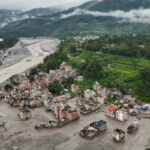
For generations, disasters in the Himalayas, earthquakes, floods, landslides, glacial events were understood as acts of God, unpredictable and, in a sense, beyond argument. Now, climate change has rewritten that story.
I make this observation not as a climate scientist or a policymaker, but as someone who sits closer to where climate risk meets daily life. I do not view climate change as a theory or a diplomatic declaration. I see it as damaged assets, disrupted livelihoods and delayed recovery. That is the lens I want to bring to this discussion, particularly at a moment when Nepal is still absorbing the damage from its most recent floods.
Floods, once seasonal and largely rural, are increasingly sudden and urban. Landslides, once isolated events, are increasingly cascading. Glacial risks, once distant projections modeled decades into the future, are arriving faster than anticipated. Heat stress, extreme cold, drought, fire, and water scarcity are quietly compounding on top of all of this. But the deeper change is not simply in frequency or intensity, it is in uncertainty itself. And uncertainty is the most corrosive risk of all, for households, for businesses, for governments and, I would add, for insurers.
This is also why disasters today can no longer be described purely as “natural.” Climate change blurs the line between the natural and the man-made. A flood becomes a financial disaster when homes are uninsured, when supply chains break, when livelihoods disappear and migration accelerates consequently. A landslide becomes a social disaster when settlements sit on unstable slopes, when women and the poor absorb the longest recovery periods, and when rebuilding pushes families into generational debt. A climate shock becomes a development setback the moment scarce public capital is diverted from growth to recovery. In other words, these are no longer only environmental events. They are economic shocks, social shocks and fiscal shocks, arriving together.
Let me offer one small, human example. After a localized flood a few years ago, a small business owner told us:”The water receded in two days, but it took two years for me to recover.” The damage, in absolute terms, was not extraordinary. What made recovery so slow was the absence of a financial buffer, no insurance, negligible external support, and no safety net. What followed was predictable: borrowing at high interest, selling assets, and disruptions to children’s education, decisions that had little to do with the flood itself and everything to do with financial vulnerability. This is how a climate event quietly becomes a life-altering one.
So where does insurance fit into this picture?
Insurance is widely misunderstood. Most people associate it with compensation after a loss. In reality, insurance is about confidence before loss. At its core, it answers a simple human fear: what happens if the unexpected happens? Will my family be protected? Will my business survive? Will I be able to recover? I often summarize this in four words: protection against the unexpected.
But in a climate-stressed Himalayan region, protection cannot remain static, it has to evolve. The traditional model of insurance was built on stable historical patterns and reasonably predictable risk. Climate change breaks that foundation. Past data no longer reliably predicts future risk. Losses cluster instead of spreading, and extreme, unforeseen events increasingly strain the financial resilience of insurers themselves.
This means the relevant question is no longer simply whether insurance can pay claims. The relevant question is whether insurance can help societies adapt, whether it can function as a genuine tool for climate resilience. My answer is that it can, but only if the industry moves upstream rather than remaining purely downstream: not only paying claims after disaster strikes but actively helping to reduce risk before it does.
That shift requires rethinking how the sector operates, in at least four ways. First, from compensation to prevention: premiums should reward safer construction, better land use and more resilient infrastructure, rather than simply pricing risk after the fact. Second, from exclusion to inclusion: micro-insurance, parametric insurance and community-based risk pools can extend protection to farmers, informal workers and small businesses who are currently priced out or overlooked entirely. Third, from individual loss to systemic resilience: insurance data, aggregated responsibly, can inform urban planning, infrastructure investment and disaster preparedness at a scale far beyond any single policyholder. Fourth, from national silos to regional cooperation: climate risk does not respect political borders, and risk-sharing mechanisms should not either.
Partnership matters here because no single actor can do this alone. Climate adaptation requires strong policy. Climate finance requires international cooperation. But resilience at the household and enterprise level requires risk transfer and that is where insurance does its quiet, often invisible, work. Insurance, however, cannot function in isolation. It depends on sound regulation, climate-informed policy, public trust and financial literacy, all of which have to be built deliberately rather than assumed.
My call to policymakers, insurers and development partners is straightforward. Policymakers should see insurance as more than a financial product. It is a risk infrastructure worth investing in and regulating accordingly. Insurers should see climate change not as an uninsurable threat to be priced out of the market, but as a call to innovate. Development partners should integrate insurance more deliberately into adaptation and resilience planning, rather than treating it as an afterthought to grants and loans. And this region, I would argue, should lead rather than follow in designing Himalayan-specific solutions, since our risk profile is genuinely distinct from that of other geographies.
The Himalayas have always taught humility. They remind us that human ambition must respect natural limits, and they remind us, in equal measure, of the resilience of communities that rebuild, adapt and endure. Insurance, at its best, is a quiet partner in that resilience, not dramatic, not particularly visible, but present when everything else fails. In an age of climate uncertainty, that quiet presence is no longer optional. It is, simply, protection against the unexpected.

Mahendra Krishna Shrestha is the Chairman of Himalayan Everest Insurance (HEI) and an Advisory Board Member at the Nepal Economic Forum (NEF), where he combines hands-on leadership in the insurance sector with a deep commitment to strengthening Nepal’s economic resilience and policy dialogue.