General Overview
As close neighbors, Nepal and Bangladesh have always enjoyed excellent relations characterized by tremendous goodwill, solidarity, and respect. Nepal was the seventh country to recognize independent Bangladesh in 1971. Although formal diplomatic relations were established in 1972, the connections between our people, through trade and cultural ties, predate that milestone. Our relationship is grounded not only in geographic proximity but also in shared language, culture, traditions, and way of life.
Our two countries have always stood by each other in times of need, while acknowledging each other’s aspirations and sensitivities. Rooted in a true spirit of neighborliness, our relationship is also about a similar development story. We are co-authors of an evolving story of efforts and adventures, and challenges. These efforts and adventures have been at times modest and at times ambitious but always deeply aligned, and in sync.
Having said that, whenever we reflect on Nepal-Bangladesh relations, we often speak of the immense potential and possibilities but also acknowledge the limited progress achieved thus far. There is a shared understanding that much remains to be done. In this context, it will be useful to identify clear guideposts aligned with the present realities and future priorities.
To unlock the true potential of this relationship, we must be willing to rethink, reform, and realign our policies and institutional frameworks. This requires a fresh and forward-looking approach — one that prioritizes the mutual benefit of our people.
Trade and Connectivity
While it is true that our current economic engagements remain modest in scale, we have nonetheless made significant headway in several key areas, including trade, investment, connectivity, and tourism. We have been negotiating a Preferential Trade Agreement (PTA) aimed at boosting our bilateral trade. A dedicated Trade Negotiation Committee (TNC) has been tasked with negotiating the PTA text and finalizing product lists.
In addition to this, it is essential to enhance trade and investment linkages, including by eliminating or reducing the other duties and charges (ODCs) and addressing logistical and procedural challenges. In parallel, we must also work towards harmonization and standardization of customs procedures, trade regulations, digital standards, and environmental policies, which are critical to fostering a more seamless and efficient trading environment.
These efforts gain added urgency as both our countries are set to graduate from the Least Developed Country (LDC) category by 2026. Of course, while graduation is a major development milestone for both our countries, it also brings challenges, including due to the loss of international support measures. So, we continue to share our experiences and lessons learned, particularly in regards to smooth transition strategies, and work together for a smooth, sustainable, and irreversible graduation.
We all know, as is any other bilateral context, connectivity is the beating heart of our relationship. At present, two airlines – Biman Bangladesh and Himalaya Airlines – are operating as many as 13 direct flights per week between Kathmandu and Dhaka. However, on the trade front, the Kakkarvitta-Fulbari-Banglabandha corridor remains the only operational land route.
We appreciate Bangladesh’s gesture in granting Nepal access to Mongla and Chittagong seaports. Yet, utilization of these ports has thus far been limited, primarily due to distance and higher transshipment costs. But we are exploring ways to better utilize these ports for third-country trade and broader connectivity goals.
On the sub-regional level, ongoing negotiations under the Bangladesh, Bhutan, India, Nepal (BBIN) framework on the movement of cargo and passenger vehicles represent a vital step for connectivity. We believe that the successful conclusion of these discussions, by addressing each other’s concerns, if any, will be a significant milestone towards achieving seamless road connectivity in the sub-region.
Energy Cooperation
When we deliberate on Nepal-Bangladesh ties, energy cooperation is seen as a promising avenue. The implementation of the first-ever trilateral power-sales agreement among Nepal, Bangladesh, and India signed on the October 2, 2024 and the historic power flow of 40 MW hydroelectricity from Nepal to Bangladesh via the Indian grid has opened a new chapter in our economic partnership. With this, regular transmission of power is scheduled to occur for five months annually from mid-June to mid-November, aligning with Nepal’s peak energy generation period.
We know that this is just a small step but it carries symbolic significance as it has the potential to generate new momentum for cooperation in the power sector both at bilateral and sub-regional levels. With a view to building on this momentum, talks are underway for a joint venture agreement between our two governments for the development of the 683 MW Sunkoshi III hydropower project. Additionally, Bangladesh authorities are negotiating with the GMR Company of India in finalizing the deal for importing 500 MW of electricity from the 900 MW Upper Karnali Hydropower Project.
Given Nepal’s immense hydropower potential and Bangladesh’s growing needs, energy cooperation is indeed a ‘sunrise industry’. So, it is imperative that we move beyond this symbolic beginning and strive to promote hydropower cooperation as the centerpiece of our bilateral relations.
Tourism and People-to-People Contacts
Cultural ties and people-to-people connections have long been the bedrock of our enduring friendship. These bonds are rooted in history and shared values; and consolidated by continuous exchange over the centuries.
Great Bengali scholars and philosophers such as Atish Dipankar and Vanaratna travelled to Nepal centuries ago to spread the teachings of Buddhism. It was in 1908 when renowned Bengali scholar Haraprasad Shastri discovered a palm-leaf manuscript of the the Charyapada — a collection of ancient Bangla poems — in the Royal Court of Nepal.
Our shared linguistic heritage is further evident in the fact that Sanskrit serves as the linguistic origin of both Nepali and Bangla languages. We celebrate common festivals, enjoy similar cuisines, and uphold many shared customs and traditions.
A vibrant example of our growing people-to-people connections is the tradition of Nepali students pursuing higher education in Bangladesh, especially in the field of medical studies. Currently, about 2700 Nepali students are studying in various universities across Bangladesh. Likewise, Nepal continues to be a favored destination for Bangladeshi tourists, with close to 50,000 visitors recorded in 2024.
These grassroot-level connections and exchanges have played a vital role in deepening our warm and friendly ties. We aspire to see these interactions grow in both directions. To this end, we must facilitate easier travel, expand scholarship opportunities for our students, and promote further cultural linkages, ensuring that our friendship is not only between governments, but also deeply rooted in strong people-to-people connections.
Need for Renewed Outlook
It is indeed a matter of satisfaction that Nepal Economic Forum (NEF) and the Centre for Policy Dialogue (CPD) have come together to undertake a study on ‘Nepal-Bangladesh Relations- A Renewed Outlook’. I commend both institutions for their commitment to fostering dialogue, generating knowledge, and strengthening bilateral cooperation. I am confident that the study will delve into all critical aspects of our partnership, offering fresh insights and actionable recommendations to enhance collaboration between our two countries.
Of course, we all understand that this is easier said than done. It is often said that in diplomacy, we think and talk in ‘poetry’ but act in ‘prose’ because the challenges we face are real, and at times, formidable. Yet, we now stand at a pivotal moment to shape the future of Nepal–Bangladesh relations in a manner that is both ambitious and anchored in grounded realities. I hope the research team will rise to the occasion and do full justice to this opportunity.
I wish them every success in their endeavor.
This article is based on Ambassador Bhandari’s remarks at the Dhaka Roundtable on August 3, 2025, entitled “Nepal–Bangladesh Relations: A Renewed Outlook.”
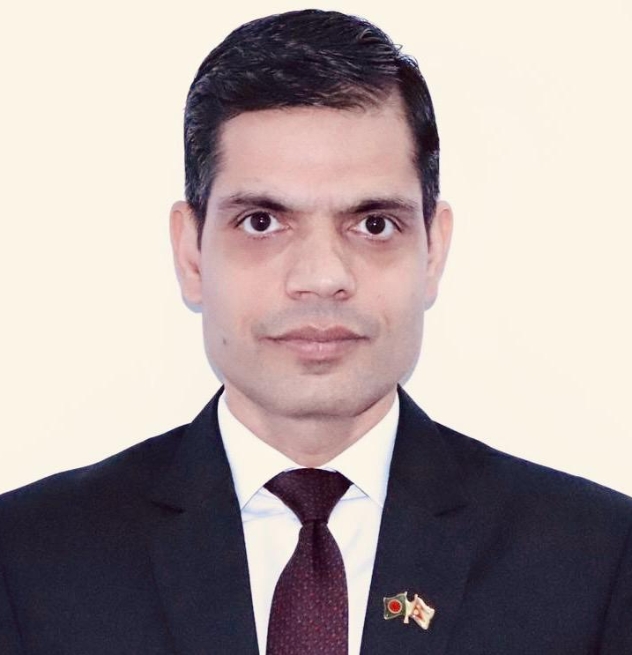
Ambassador Ghanshyam Bhandari, appointed on 31 July 2022, serves as Nepal’s Ambassador to Bangladesh. He previously held senior roles at Nepal’s Ministry of Foreign Affairs and missions in New York, Brussels, and Geneva. A former lecturer, he holds an MPhil in English Studies and a master’s in Political Science from Tribhuvan University.