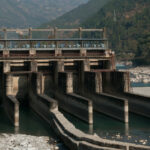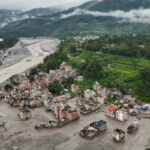
In recent years, Nepal has suffered both natural and man-made disasters. On August 26, Nepal was rocked by a flash flood that destroyed billions of dollars’ worth of houses, hydropower plants, bridges, and cars in less than a day. This occurred within a year of the September 2025 protests which was punctuated by widespread damage to buildings and auto-vehicles. These instances have raised the question: For a country constantly plagued by disasters, why is insurance not a bigger part of the risk management discourse?
A chronic lack of insurance coverage remains a critical issue in Nepal. Non-life insurance, also known as general insurance, covers areas such as auto and property. For developing economies, the level of non-life insurance penetration, which is a metric that shows the relative size and economic importance of insurance within a national economy, is strongly correlated with positive economic growth.
Disasters, such as climate shocks, have had significant impacts on Nepal’s economy in the past. The 2015 Gorkha earthquake resulted in USD 5.2 billion (NPR 806.08 billion) in damages and USD 1.9 billion (NPR 294.53 billion) in economic loss. However, only USD 210 million (NPR 22.68 billion) worth of the damaged properties were insured. Non-life insurance penetration, which is equal to total gross premiums divided by Gross Domestic Product (GDP), did grow from 0.49% in 2015 to 0.58% in 2016, however the subsequent annual growth rate topped out at 0.04% until the COVID-19 pandemic in 2020. Since then, the penetration growth rate has stagnated at 0.7%.
Sustainable economic development amid disasters is contingent upon a recalibration of the public’s perception of, and access to non-life insurance. Changing this requires greater action by regulators to force compliance from insurance firms.
Overview of the National Insurance Sector
The non-life insurance industry in Nepal is composed of 18 firms, with four classified as micro-insurers. In FY 2081/82 BS (FY 2024/25 AD), the total amount of insurance premiums collected by these firms amounted to NPR 43.94 billion (USD 283.93 million), an increase from NPR 29.82 billion (USD 192.69 million) in FY 2077/78 BS (FY 2020/21 AD) The most significant firm in the non-life sector is the Rastriya Beema Company Limited (RBCL), a state-owned insurance firm with NPR 24.08 billion (USD 155.59 million) in total assets, as of FY 2081/82 BS (FY 2024/25 AD). RBCL also has the third-highest market capitalization value of all insurance firms, life and non-life, listed on the Nepal Stock Exchange (NEPSE), and has the third-highest share price of any NEPSE-listed company.
Comparatively, the life insurance sector collected NPR 182.17 billion (USD 1.17 billion) in premiums in FY 2081/82 BS (FY 2024/25 AD). For further context, RBCL would only be the 11th largest firm by total assets in the life sector which is composed of 17 firms, three of which are micro-insurers.
Misalignment of Insurance Priority
Nepal’s insurance industry possesses a significant dichotomy between the life and non-life sectors.
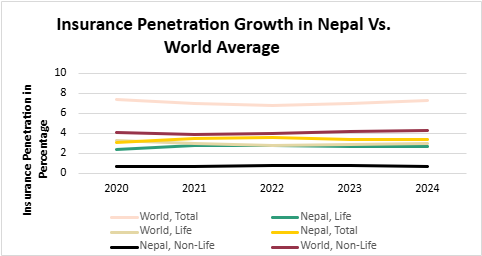
Figure 1. Insurance Penetration and Growth in Nepal Vs. World Average (Nepal Insurance Authority Statistical Yearbook 2081/82 & Monthly Non-Life Insurance Business, Shrawan, 2083)
Nepal’s life insurance penetration is aligned with the global average of 3.0% with only a 0.3% difference in 2024. Additionally, the global average for non-life insurance penetration mirrors that of its life counterpart. However, Nepal’s non-life insurance penetration is substantially lower than the global average at only 0.7% compared to the global average of 4.3%.
Moreover, the non-life sector is skewed toward auto insurance, rather than segments that are the most difficult to rebuild following a disaster, such as property.
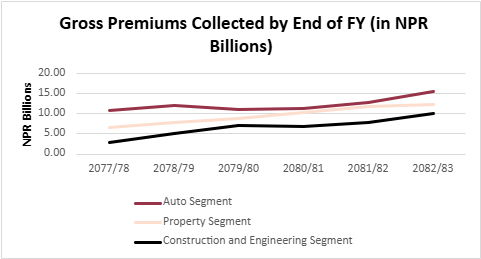
Figure 2. Gross Premiums Collected by End of FY (in NPR billions) (Nepal Insurance Authority Statistical Yearbook 2081/82 & Monthly Non-Life Insurance Business, Shrawan, 2083)
Auto insurance has dominated the non-life insurance business, but recent years have seen property insurance beginning to close the gap, alongside a rapid growth in engineering and construction insurance. FY 2082/83 BS (FY 2025/26 AD) did experience a widening of the gap; however, that is attributed to heightened awareness of vehicle protection following the September 2025 protests.
The Core Factors Perpetuating the Imbalance
The perception of non-life insurance in Nepal is relatively weak, with most small and medium-sized enterprises (SMEs) foregoing it in their operations as they view it as a luxury, rather than a tool for sustainability. This is caused by the thin profit margins these companies operate with, yielding minimal additional capital expenditure beyond what is required for day-to-day operations. This reluctance in engaging with non-life insurance extends to their personal property, as well. As such, entrepreneurs instead employ non-robust coping strategies, such as savings or loans, when faced with economic hardship brought about by disaster. A common misconception amongst SMEs is that insurance is reserved for large businesses. This is caused by a poor communication pipeline between insurance firms and entrepreneurs, as well as a mismatch between the needs of SMEs and the insurance products on offer.
Additionally, public trust is undermined by the lack of operational efficiency in the insurance sector, as evidenced by the fact that, as of September 9, 2026, of the claims filed for affected property in the September 2025 protests, only 38% have been settled. Per regulations under the Insurance Act, 2079, operators must follow a specified timeline when responding to a claim. This process is initiated upon the submission of a claim with the immediate appointment of a surveyor to assess damages, a 15-day limit to conduct the assessment, and the post-report payout within three to five weeks. Financial penalties are also levied on insurance operators for arbitrary delays. The Non-Life Insurers’ Association asserts that this figure is not representative of the situation as most smaller claims have been settled and the figure is dragged down by the large claims for which damage survey reports have only recently been submitted. Nonetheless, such a delay further erodes the already limited confidence entrepreneurs have for insurance products.
Recent Developments
There have been regulatory advancements in the insurance industry in the last few fiscal quarters, with actions taken by the Ministry of Finance (MoF), as well as the Nepal Insurance Authority (NIA). The MoF, in a bid of proactive risk management strategy, has paved the way for expansion in the non-life insurance sector by mandating insurance for urban building permits and transportation, increasing the third-party liability coverage from NPR 500,000 (USD 3230.88) to NPR 1 million (USD 6461.77), and expanding risk transfer instruments for disaster compensation and reconstruction. This is accompanied by the NIA issuing a directive in February mandating non-life insurers to formulate insurance policies based on an index developed in-house that pre-determines the payout for damage caused by weather and natural disasters. This financial product is also known as parametric insurance. This index must factor in the geographical structure which the property is located in, the target group taking out the policy, and the specifications of the weather and natural disaster risks being insured against.
The introduction of parametric insurance provides the general public with increased transparency and predictability, which may increase non-life insurance penetration assuming the public is adequately informed of the changes. However, regulation is only as effective as its enforcement, which the post-September dilemma has demonstrated is weak in the current environment. Additionally, as of October 4, 2026, only Shikhar Insurance Company Limited and Sagarmatha Lumbini Insurance Company Limited have rolled out parametric insurance products.
Way Ahead
With Nepal’s vulnerabilities to natural disasters, particularly for households and Micro, Small and Medium-sized Enterprises (MSMEs), state actors must not simply pass legislation, but also enforce compliance via strict regulation and supervision. The general public must be convinced of the benefits of non-life insurance in addition to trusting that the premiums they pay will actually yield protection and compensation when damages occur.
A country’s insurance penetration is a strong general proxy of economic robustness, particularly for a developing country whose citizens have lighter savings and less financial sophistication. Insurance is the hedge for natural disasters, and Nepal must prioritize connecting its people with this risk management tool if it seeks to achieve protect its people and assets.

Aadit Kattel is a Mathematics and Economics undergraduate at the University of London. He is driven by investigating the impact financial institutions have on the political economy, with a focus on how sovereign wealth funds influence the global economy. He previously interned at Muktinath Bikas Bank in the corporate finance department and was a freelance AI trainer at Outlier AI.