
Nepal’s aviation journey began in 1949 with its first flight landing in Kathmandu. Later, in 1955, Tribhuvan International Airport (TIA) was inaugurated by King Mahendra and was upgraded with a concrete runway in 1964 after Nepal joined the International Civil Aviation Organization (ICAO) in 1960. Following this, the Civil Aviation Authority of Nepal (CAAN) was established as an autonomous body under the Ministry of Culture, Tourism and Civil Aviation, and was tasked with regulating and managing the growing aviation sector in 1998.
With the rising need for additional international airports, Nepal built its second and third international airports in Lumbini and Pokhara to dilute the air traffic in TIA, as well as to attract tourists in the country. Over the past decades, the country has also constructed 52 domestic airports over its seven decades of aviation history. The current status of Nepal’s aviation industry is further illustrated in the table below:
Table 1. Status of Aviation Industry in Nepal
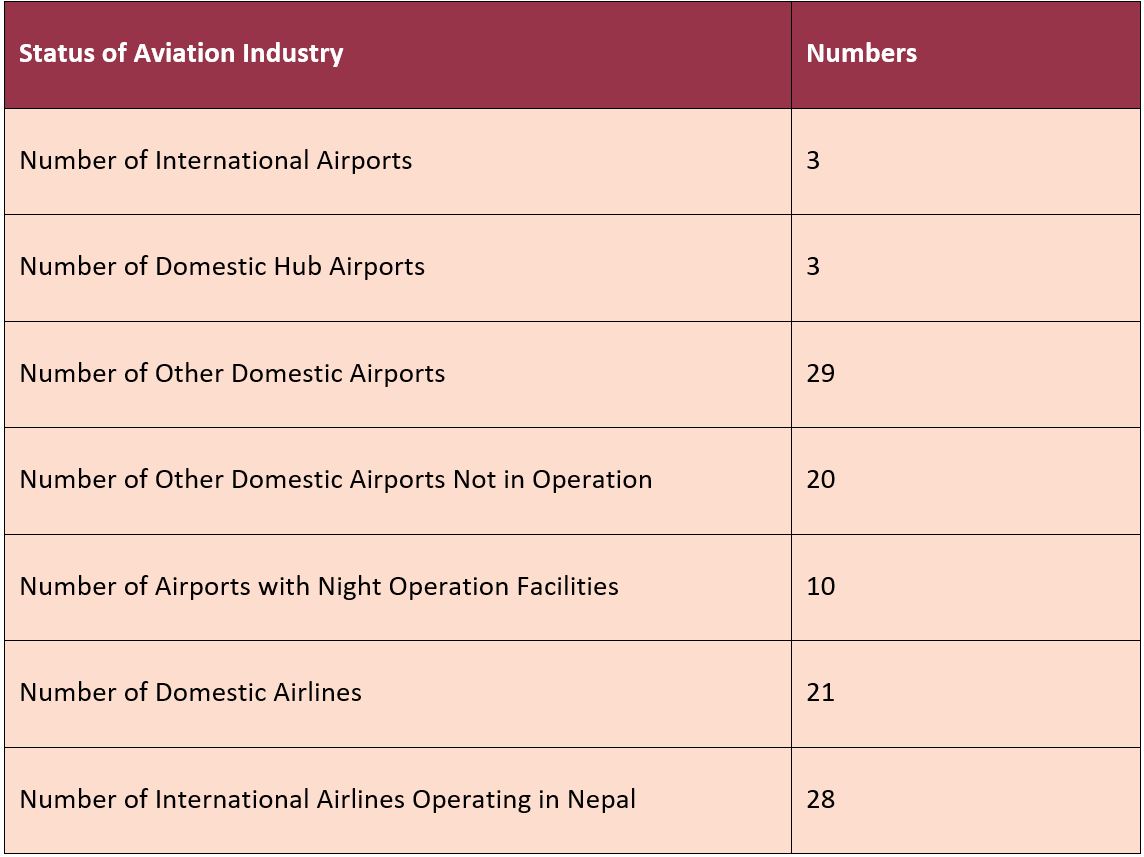
Source: CAAN Report 2024
However, while Nepal has made visible strides in developing its aviation infrastructure and has immense potential as a tourism hub, coupled with increasing travel and migration among Nepalis, policy execution has lagged behind, and the international perception remains deeply unfavorable. The blacklisting by the European Union (EU), repeated air crashes claiming many lives, and persistent inefficiencies at major airports, have severely tarnished the country’s aviation reputation. These issues point to deeper operational and policy shortcomings, both in international and domestic airports, which are further explained below.
Economic Challenges
Over one-third of Nepali airports lie defunct, reflecting how infrastructure planning remains detached from long-term demographic and economic projections. Previously, airports were built in remote places with no road access which helped locals to connect to the rest of the world. However, the situation has changed, as those places now have access to motorable roads. This facility, in turn, has dried the number of flights in the region as transportation through roads became more affordable than the airfare. Thus, the plummeting frequency of flights has made various airports unfeasible, leading to their total closure.
Apart from this, the inadequate feasibility study of projects is also to be blamed for the economic hardship that the airports are facing currently. Airports are being built without considering factors such as proximity to other airports, population density, economic status of the region, and return on investment of the airport. Thus, only eighteen airports of Nepal are operating profitably. In particular, the key examples of unfeasibility include Gautam Buddha International Airport (GBIA) and Pokhara Regional International Airport (PRIA).
GBIA, built with the total investment of USD 76 million, generated a revenue of NPR 211.39 million for CAAN in 2023. Similar income trends would take GBIA more than 50 years to cover the cost of construction alone. Even if traffic doubled, it would still take more than 25 years to reach break-even.
PRIA faces a similar situation. The airport was constructed with a total investment of NPR 25 billion but has been unable to attract commercial flights since its inception due to various reasons. As a result, PRIA collected a revenue of only NPR 349.36 million in 2023 with domestic flights. If PRIA fails to attract international flights, it would take at least 75 years for PRIA to repay the high-interest bearing debt which fuels the Chinese ‘debt-trap’ narrative.
Geographical and Environmental Challenges
The uneven terrain in Nepal poses high challenges to the aviation industry. It makes flights riskier and the construction of airports costlier. The rough terrain of the north makes it difficult to fly via China and compels Nepal to be dependent on India for air routes. Due to these geographical obstacles, more than two-third of airports in Nepal are Short Take-off Landing (STOL) airports which can only accommodate small airplanes that strictly limits the profitability of airlines as well as airports. PRIA and TIA are also surrounded by hills and uneven topography which heightens the risk. Even in the plains, GBIA faces difficulty in operating flights due to the low visibility during winter season.
Geopolitical Challenges
As with most other things in Nepal, the fact that the country borders two geopolitical powerhouses has had an effect in the aviation industry as well. Nepal has been using the Indian airspace for air-commute since the inception of airways in Nepal. But both recently built international airports, GBIA and PRIA, were built by Chinese companies. The funds for PRIA were also availed through Chinese loans and the project was declared as part of the Belt and Road Initiative (BRI) by the Chinese Ambassador to Nepal. As a response to this increasing Chinese involvement, India has not provided an air route to Nepal despite multiple requests. Thus, the unavailability of shorter air routes has increased the flight time for the airlines and made operation costs higher, making new airports unattractive. This flaw in aviation diplomacy has kept the two international airports under-utilized.
Policy and Governance Challenges
Beyond geopolitical challenges, policy and governance mechanisms in Nepal’s aviation industry are also faced with various problems. The regulatory body of the aviation industry, CAAN, is often criticized for its regulatory failures, transparency, accountability, and its inability to meet international safety standards, leading to Nepal being blacklisted by the European Union (EU) since 2013. This reflects systemic governance failures as CAAN’s dual role as both regulator and operator creates a conflict of interest, thereby impeding enforcement of safety standards. CAAN has also been embroiled in various corruption cases and scandals.
For instance, the Aviation Policy 2006 states that airports are to be built considering the geographical location, population density, tourism promotion, regional balance, returns on investment, and proximity with another airport. Despite the policy, politicians often push for airport construction in their constituencies to fulfill their election promises, regardless of the technical or financial feasibility. For example, the minimum distance between two airports is 20 nautical miles (37.04 km) in mountains and 40 nautical miles (74.08 km) in Terai. Yet, there are instances where CAAN itself has breached the policy giving in to the political pressures resulting in redundant or poorly located airports.
Furthermore, currently there are two bills – the Civil Aviation Authority of Nepal Bill and the Air Service Authority of Nepal Bill – which envisage splitting Nepal’s aviation body into two entities as regulators and service providers. However, these bills have been in a legislative loop for over decade and a half. Fast-tracking these bills is essential to align Nepal’s aviation policy with international norms and to remove Nepal from the EU air safety blacklist.
These governance failures are not merely technical but reflect deeper institutional inertia and lack of reform. Without clear demarcation of roles and professional oversight mechanisms, efforts to modernize Nepal’s aviation industry will remain superficial.
The Way Forward
While Nepal has achieved concrete gains in expanding aviation infrastructure, its long-term strength lies in operational excellence, governance, and safety reforms. Taking examples from countries like India, which onboarded private companies for the management of airports, and Rwanda, which took the public-private partnership route to revamp its airports, Nepal can build lean systems beyond physical infrastructure as well. Further, emphasizing international safety compliance, personnel training, and performance-based management structures, like in Singapore, can restore global confidence. Likewise, aligning CAAN with ICAO standards, and separating regulatory and operational roles could skim out institutional inefficiencies. Aviation investments should also be economically viable, diplomatically balanced, and institutionally sound. Only through such focused and adaptive interventions can Nepal’s aviation sector really take flight.

Sujal Budhathoki is an intern at Nepal Economic Forum. He has completed his Bachelor of Business Administration from Tribhuvan University, specializing in Banking and Finance. He has previously interned at NIC Asia Bank Limited. His interests lie in the field of management consulting, economic policy and sustainability.