The annual meeting of the World Economic Forum (WEF), held in Davos, Switzerland, is one of the most significant events on the global calendar. This year it attracted exceptional attention, as over 60 heads of state, a record 400+ political leaders, and 830 CEOs attended the meeting.
One of the highlights of this year’s forum was the speech by the Canadian Prime Minister, Mark Carney, who candidly addressed the way the global order has been challenged in recent years. He talked, “about the rupture in the world order, the end of a pleasant fiction, and the beginning of a harsh reality where large, main-power geopolitics faces no limits, no constraints.”
Many analysts compared this moment to British Prime Minister Winston Churchill’s speech on May 5, 1945. While Churchill offered the metaphor of the ‘The Iron Curtain,’ Carney used the metaphor of the ‘Sign in the Window’ borrowed from Czech statesman Vaclav Havel’s essay – The Power of the Powerless.
Carney explained it in his own words:
“Every morning, this shopkeeper places a sign in his window: ‘Workers of the world unite.’ He doesn’t believe it, no one does, but he places a sign anyway to avoid trouble, to signal compliance, to get along. And because every shopkeeper on every street does the same, the system persists – not through violence alone, but through the participation of ordinary people in rituals they privately know to be false.”
Havel called this “living within a lie.”
In Unleashing the Vajra, I wrote about how the speech by Chinese President Xi Jinping at the 2017 Davos meeting positioned China as the custodian of globalization at a time when the world was grappling with President Donald Trump’s election as the US President, merely two months before this address. This time, it was the Canadian Prime Minister who articulated a new paradigm, as the world witnessed how the US President is approaching his second term.
Globalization continues to get redefined and rearticulated.
Reglobalization
In my book Nepal 2043, I had quoted the Foreign Minister of India, S. Jaishankar on emphasizing the world re-globalization, a term used by Ngozi Okonjo-Iweala, the Director- General of the World Trade Organization (WTO). He talked about “a more diversified version with more democratic globalization, where the global South will equally benefit.”
I talk about the four factors that will impact this reglobalization. First, the large size of private companies that shape government policies. The optics of government-business meetings in India or the US in 2025 provide much evidence to this. Second, the rise of China is becoming prominent, whether its trade with the Association of Southeast Asian Nations (ASEAN) exceeding trade with the US or its growing influence in Africa or Latin America. Third, I talk about the reduction in aid and the decreasing number of countries dependent on aid, and finally, how the future of economic growth will be Asia-centric.
I have continuously written about how the two large economies, China and India, are finding ways to collaborate and that will continue. The pace of this re-globalization is being accelerated. Prime Minister Carney just provided more perspective on the direction of this reglobalization.
What It Means for Nepal
I have continuously been a cheerleader for Global Nepalis who have made more than 180 countries their home and understood how to take advantage of globalization, knowingly or unknowingly. For me, globalization is a paradigm to understand and ride on.
In Unleashing the Vajra I write:
“Globalization can be understood as the seamless process of integration between global markets and citizens worldwide. It is important to understand globalization not just from the perspective of the market economy but also from a sociocultural perspective as the simultaneous globalization of attitudes, ideologies, and practices. From human rights campaigns to animal rights activism, from religion to the horrors of terrorism, and from the spread of culinary delights to the sound of music. For Nepal, the challenge is not just one of market integration but of identifying and capitalizing on its unique brand and identity so that it can contribute to and benefit from the socio-economic process of globalization.”
For Nepal and Nepalis around the world, it is important to understand the direction in which the world is moving and find opportunities accordingly.
If the shortfall of skilled workers in Europe reaches 85-90 million in 2040, then Nepal must explore how its people can benefit through formal arrangements. If there are more visa restrictions between countries in South Asia, how can Nepal position itself as a neutral venue for dialogue and cooperation?
Nepal can ride on its neutral global image and promote its cuisine, culture, music, art, and literature. Artificial Intelligence (AI) and technological revolutions will only accelerate these processes. If people around the world are increasingly stressed, Nepal can emerge as a global destination for physical and mental wellness.
Every rupture creates opportunities, it is to up to us to seize it.
Nepalis can articulate their own position in the world, I tried replacing the word Canada with Nepal in Prime Minister Carney’s speech. It now reads:
“Nepal is a pluralistic society that works. Our public square is loud, diverse, and free. Nepalis remain committed to sustainability. We are a stable and reliable partner in a world that is anything but. A partner that builds and values relationships for the long term.”
Now, this sounds like a great place to start from, doesn’t it?
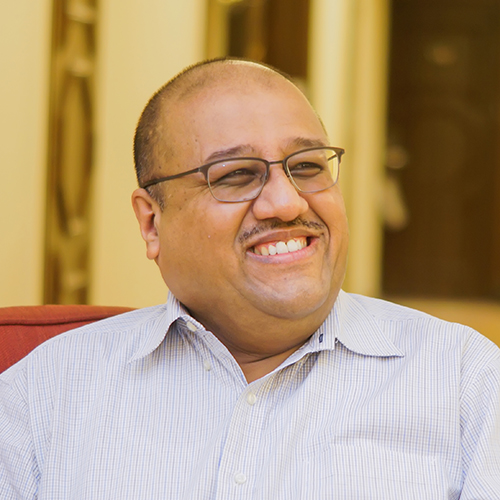
Sujeev is the founder CEO of beed. He leverages over 25 years of experience in diverse fields and geographies to advise, lead and inspire. With comprehensive networks in Nepal’s public, private, civil and diplomatic sectors, Sujeev is a trusted business and policy advisor and respected strategic thinker. From economies of developing countries to economies of human beings, he moves across different worlds, with his passion for the Himalayas being the axis.