It is widely acknowledged that education has become a fundamental right, guaranteeing many a secure future with fewer financial problems. However, to what degree does education affect the economic conditions of an individual and help eradicate poverty? Many economists have speculated that poor education has a core relationship with poverty, leading to the development of numerous theories over the years. A few notable examples include the human capital theory and the poverty trap theory. The human capital theory focuses on how factors such as education influence poverty. In contrast, the poverty trap theory explains how poverty limits access to essential factors, such as education, thereby creating a self-reinforcing cycle that keeps individuals trapped in poverty.
Human Capital Theory
The human capital theory, by Theodore Schultz and Gary Becker, views education, skills, health, and other human qualities as capital that can be invested to increase productivity and earnings. In other words, as individuals invest in their education, they will increase their productivity and skills, thereby securing a higher income, as noted in the book ‘Poor Economics’ by the 2019 Nobel Prize winners Abhijit Banerjee and Esther Duflo. The book presents a case study of Indonesian adults who benefited from the INPRES program, through which 61,000 primary schools were constructed throughout the country. According to the research, it was found that adults who grew up in areas with more schools constructed had significantly higher wages than those in other areas. They concluded that with every extra year of primary schooling, wages increased by 8%. This illustration aligns with the human capital theory. As the Indonesian government invested in children’s education, their skills and knowledge developed drastically compared to others. This provided individuals with higher earnings and diverse job opportunities, enabling them to improve their economic status significantly and escape poverty, thereby demonstrating the impact of education on reducing poverty.
Poverty Trap Theory
The poverty trap theory, on the other hand, explains how persistent self-reinforcing poverty forms and becomes self-perpetuating, trapping individuals in a cycle of poverty. In terms of education, due to poor financial conditions, individuals stuck in poverty are unable to send all their children to proper school, causing them to invest all their savings into the most “intelligent” child, which leaves the remaining children without proper education. Furthermore, without proper education, the children, later in life, are unable to find sustainable, high-paying jobs, thereby trapping them in a cycle of poverty.
A striking example from the book ‘Poor Economics’ showed a family of seven children in Karnataka, India prioritizing the education of the youngest child, perceived as the most intelligent, while the remaining six children quit school after second grade to help fund the youngest’s private education. To be specific, 10% of the family’s annual income was allocated towards sending the youngest child to private school. While this ensured a secure future for the youngest child, the other six children, due to their low literacy, were unable to find high-paying jobs, keeping them trapped in poverty.
The poverty trap theory also highlights the fact that, due to poor financial conditions, individuals stuck in poverty are unable to send their children to expensive private schools and are compelled to enroll them in government schools which are less costly. According to statistics from The World Absenteeism Survey provided in the aforementioned book, private school teachers in Indian villages were 8% more likely to be present in school on any given day as compared to public schools. Furthermore, according to the Learning and Educational Achievement of Pakistan Schools (LEAPS), by the third grade, children in private schools were 1.5 years ahead in English and 2.5 years ahead in math compared to those in public schools. This illustrates how private schools are more efficient compared to public schools, resulting in a handicap for the children faced with poverty, restricting them from higher wage jobs and trapping them in a poverty cycle.
Does this Apply to Nepal?
Nepal shows signs of an inverse relationship between education and poverty. According to the Nepal Living Standards Survey-IV 2022-23, as many as 50.6% of individuals living in poverty have no education, with only 6.9% completing secondary school. This shows how much of a deep connection poverty and education have in Nepal. More than half of the people below the poverty line did not obtain the required level of education, leaving them without the proper skill set for a job, digging them deeper into poverty.
In the Nepal Journal of Multidisciplinary Research (NJMR), based on the data analysis conducted, a similar upward pattern between the Logarithm of Youth Literacy Rate (LNYLR) (15–24 years, %) and Logarithm of Per Capita GDP (LNGDP) (USD) can be seen, hinting at a positive relationship between education and income levels among Nepali citizens. This suggests that, with the increase in education, the country’s GDP will increase in the coming years, thereby supporting the human capital theory.
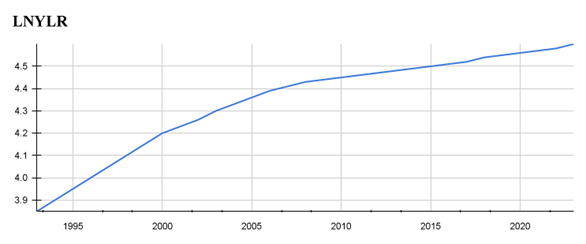
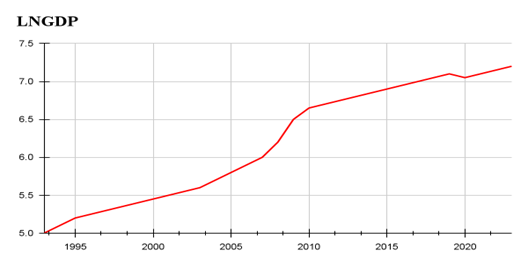
Source: Nepal Journal of Multidisciplinary Research (NJMR)
In addition, according to the Nepal Living Standards Survey-IV 2022-23, around 90% of poor households are only able to send their children to government schools, which are notorious for being inefficient, with a high absenteeism rate among teachers. According to certain estimates, teachers’ absenteeism rates in public schools are about 15-20%, causing inconsistent or even insufficient learning for the students. This suggests that, unlike private schools, the teaching at public schools is taken far less seriously. The constant absentee rate of teachers causes students to learn less consistently, making them unable to grasp the concept properly, leading to a lower literacy rate. As a result, they are unable to find a proper job, trapping them in a constant cycle of poverty. Thus, this is also consistent with the poverty trap theory outlined above.
Conclusion
In conclusion, education and poverty share a deeply interconnected and mutually reinforcing relationship. The human capital theory emphasizes how investments in education help reduce poverty, while the poverty trap theory illustrates how poverty limits access to quality education, perpetuating a self-reinforcing cycle of poverty. In the context of Nepal, both of these theories are applicable. Similar to the human capital theory, per capita income levels are closely linked to literacy rates, with both rising proportionally. Likewise, in accordance with the poverty trap theory, the quality of education is highly dependent on an individual’s financial status, which in turn creates a cycle of poverty.
NEFtakes are short-form analytical articles that provide concise, fact-focused insights into contemporary economic issues relevant to Nepal. Designed for a diverse audience, from students to policymakers, NEFtakes offer comprehensive yet easy-to-understand analysis, using clear and accessible language with minimal jargon. The views expressed belong to the author(s); however, all articles undergo an editorial review by Nepal Economic Forum (NEF) to ensure coherence and readability.

Bibidh Tamrakar is a recent A-Levels graduate from GEMS High School, where he served as the president of the Business Club. With a strong interest in business and economics, Bibidh has actively developed leadership and analytical skills through organizing initiatives, workshops, and events for peers.