
Climate change is having significant impact in Nepal and disasters are becoming more frequent and intense over the course of this century. Accelerated glacial melt, more erratic monsoons, and rising floods, landslides, and droughts are disrupting lives and livelihoods. These shocks are undermining hard-won development gains and increasing landlessness, food insecurity, multidimensional poverty, and displacement. Climate change-induced warming in Nepal is projected to be higher than the global average, with projections of a 1.2°C to 4.2°C increase by 2080, under the highest emissions scenario. Without stronger risk management, the number of people hit by river flooding each year could double by 2030. Estimates place average annual losses from extreme climate events around USD 17 million in Nepal, with predictions suggesting these losses could triple by 2030. A 2014 Asian Development Bank (ADB) report estimates that climate-change driven events can drive a 10% loss of GDP by 2100.
In this context, acting only after disasters is fiscally unsustainable and socially unjust, especially for poor and marginalized communities. There is an urgent need for cost‑effective solutions that anticipate hazards before they strike. This article introduces anticipatory action (AA) as a proactive approach that protects people, livelihoods, and infrastructure while shifting Nepal’s disaster response from reactive relief to forward‑looking risk management.
What is Anticipatory Action (AA)?
AA lies at the nexus of humanitarian relief, socio‑economic development, and disaster risk management. It refers to assistance and protective measures implemented before a hazard fully hits, based on forecasts and agreed triggers. When flood or drought predictions cross a certain threshold, agencies can release cash and issue evacuation alerts a few days before the event’s peak. For every USD 1 invested in AA, it can yield up to USD 7 in benefits and prevent losses. Funding for AA currently comes mainly from the Central Emergency Response Fund managed by the United Nations (UN), bilateral donors backing the AA Clinic and pilots, and grants by project‑based NGOs or development partners.
In Nepal, triggers are set using weather and satellite data tracked by the Department of Hydrology and Meteorology (DHM), which issues flood warnings through SMS alerts and online bulletins. Together with United Nations Office for the Coordination of Humanitarian Affairs’ (OCHA’s) Centre for Humanitarian Data, DHM operationalizes these triggers in two stages: a seven‑day alert based on the Global Flood Awareness System (GloFAS) forecast system, followed by a three‑day warning before peak flooding. These triggers unlock predefined actions and budgets, allowing agencies to move quickly without waiting for lengthy approvals. In Nepal, actions include early evacuation, distribution of essentials, and rapid cash support to protect lives, livelihoods, and infrastructure.
In October 2024, a UN-led Anticipatory Action Framework for floods was successfully activated for communities along the Koshi River basin in Sunsari and Saptari districts of Koshi and Madhesh Provinces. Under a UN‑supported mechanism, agencies including the Food and Agriculture Organization (FAO), United Nations Population Fund (UNFPA), World Food Program (WFP), and United Nations Children’s Fund (UNICEF) collaborated to provide anticipatory support by distributing hermetic grain storage bags to farmers to protect harvests, digital cash transfers to at‑risk households, and support for water, sanitation, hygiene, and health services. This activation demonstrated how a coordinated AA plan can bring together multiple sectors, including agriculture, nutrition, health, and social protection, to reduce the impact of a forecast flood on both lives and livelihoods.
Linking Anticipatory Action and Social Protection
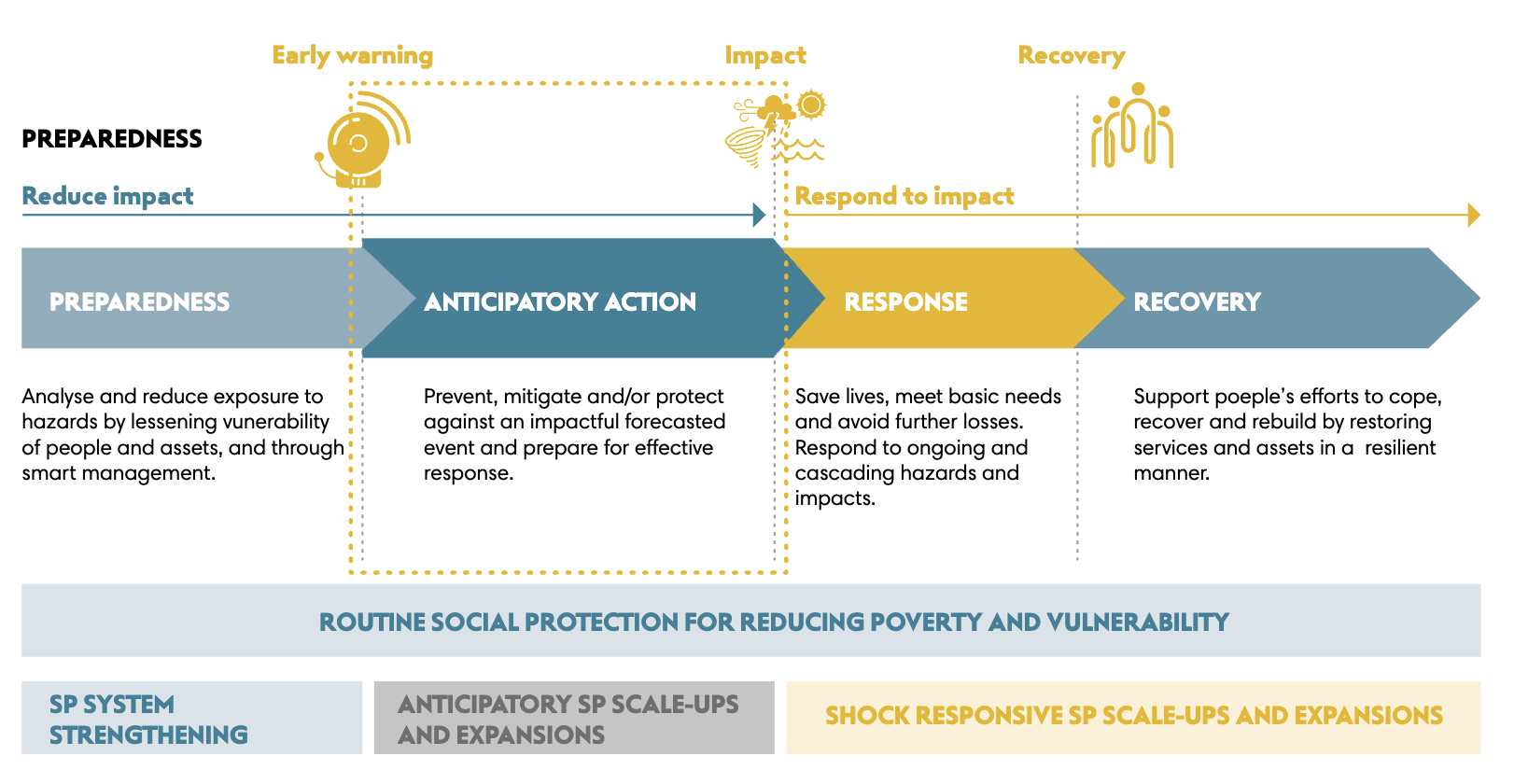
A particularly promising area globally in the integration of AA is with existing social protection systems. Figure 1 illustrates how AA and social protection complement each other across the disaster risk management cycle, enabling governments to use forecasts and early warnings to deliver cash and services before shocks strike. Embedding this approach in national systems can help reach vulnerable people more quickly and accurately, reduce costly parallel humanitarian schemes, and make early action a routine part of policy and budgeting.
Figure 1. Linking Social Protection and Anticipatory Action Along the Disaster Risk Management Cycle
Source: FAO
A Nepal Red Cross Society, Danish Red Cross, and Humanity & Inclusion pilot project tested this approach in Bardiya and Kailali districts. It combined early warning information, evacuation to safe sites, distribution of food and water, and anticipatory cash transfers delivered through the national social security allowance programme. While an effective standard operating procedure emerged, challenges remain in ensuring the most vulnerable have consistent access to social protection services.
Anticipatory Action Expansion and Institutionalization
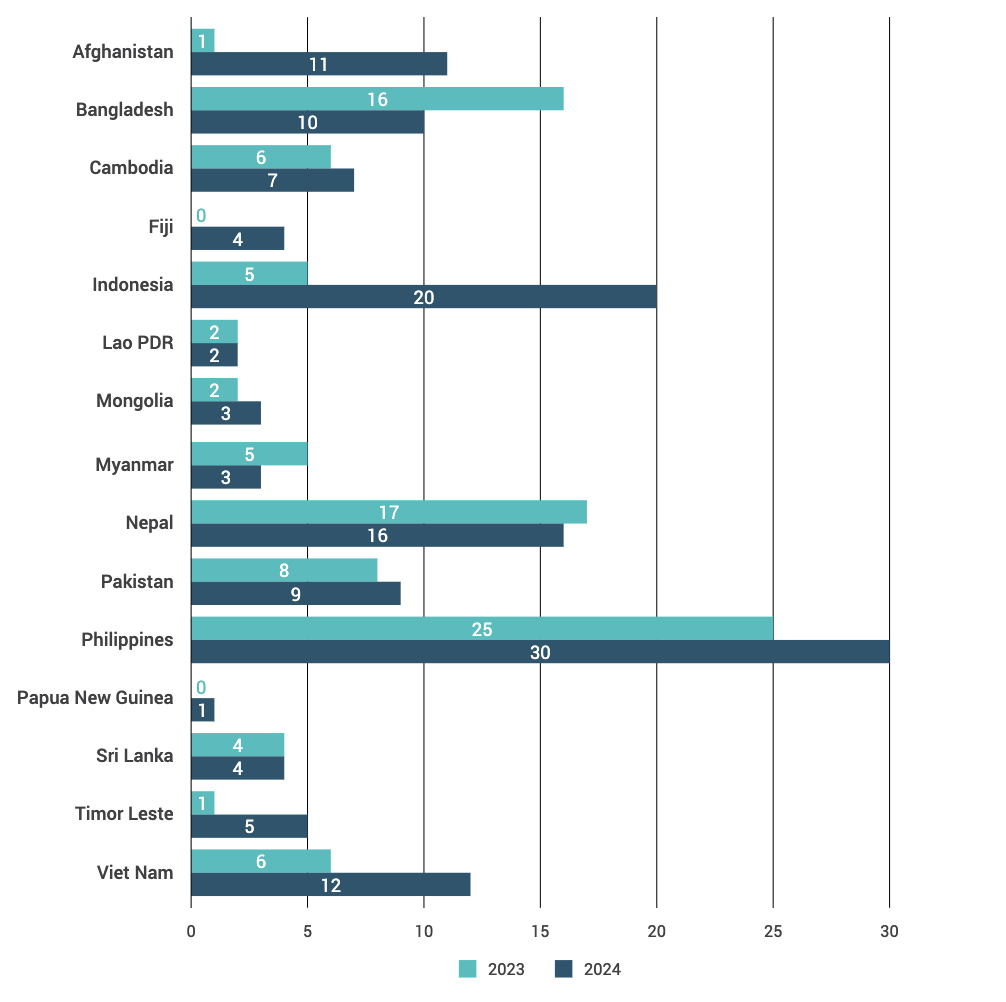
Recent regional mapping shows significant growth in AA in the Asia‑Pacific, particularly in integrating early warnings into national policy frameworks and local ownership, with notable advances in countries such as the Philippines, Indonesia and Bangladesh. Figure 2 provides an overview of anticipatory action systems implemented in various countries in the region. Though a mere 0.2% of global humanitarian funding went to AA in 2021, by 2024 this share had doubled. It remains to be seen how current aid reductions affect AA, whether they threaten the rollout of new AA programmes or redirect priority towards these cost-effective approaches.
Figure 2: Country-wise comparison of anticipatory action systems between 2023 and 2024
Source: Asia Pacific Technical Working Group on Anticipatory Action (TWGAA)
Though AA is largely led by UN agencies and NGO partners, the Government of Nepal has taken important steps to embed AA in national systems. In October 2024, the Anticipatory Action clinic was launched under the National Disaster Risk Reduction Management Authority (NDRRMA) within the Ministry of Home Affairs. The Anticipatory Action clinic hosts annual national dialogues on AA aiming to stimulate cross-pollination of ideas and support. Their mandate is also to develop a National Anticipatory Action Framework, which was initiated in January 2025. Though not legally binding, the framework lays the groundwork for future proactive disaster risk reduction management and the revision of existing national disaster frameworks and policies.
Innovation and New Frontiers in AA
NGOs and private sector partners are also collaborating and testing approaches for AA in Nepal. Funded by GSMA’s Innovation Fund for Anticipatory Humanitarian Action, Mercy Corps, in collaboration with Nepali technology company Rumsan, has implemented an innovative project in Laljhadi Rural Municipality and Punarbas Municipality in Kanchanpur District, Sudurpashchim Province which is the poorest region of Nepal with 34.16% of the population below the national poverty level. The project used Rumsans blockchain-powered project “Rahat” to send early action messages using smart contracts and efficient cash distribution to community members, with the partnership of NamastePay and Standard Chartered Bank. During the project timeline of October 2023 to January 2025, 4,500 people received early warning messages and USD 85,000 was disbursed in cash to 774 people during flooding. Such pilots illustrate how digital innovation can complement traditional disaster risk management, although issues of digital literacy, connectivity, and safeguarding still need careful attention.
Furthermore, leveraging Artificial Intelligence (AI) for more accurate forecasting, hydrogeological modelling, risk mapping, vulnerability assessments, analysis, and communication is an emerging frontier making a significant mark in AA. Recent work with AA practitioners, researchers, and technologists has shown how AI can increase the lead time and precision of hazard forecasts, support dynamic risk mapping using satellite imagery, and generate multilingual early‑warning messages that are better tailored to local contexts.
Challenges
Key challenges globally in implementing AA remain lack of sufficient funding, lack of proper policy and implementation, lack of convincing evidence base of successful interventions, and lack of technical knowledge among stakeholders. In Nepal, too, challenges persist. Nepal’s mountainous terrain and transboundary rivers hinder the development of reliable triggers for riverine flooding, particularly in the absence of strong bilateral data‑sharing such as with the Indian meteorological service. Furthermore, the draft national Cash Guideline, which would formally authorize and regulate pre‑emptive cash transfers, remains stalled between ministries, leaving agencies uncertain whether they can legally disburse funds to people before a disaster has struck. Oversight bodies have also raised concerns that such spending may appear wasteful if a predicted shock does not fully materialise. Furthermore, high turnover among government staff and political instability following the September 2025 protests may further bureaucratic inertia. Though Nepal’s institutional development around AA is relatively strong and a prominent example of AA in the region, it is yet to be seen how effectively these arrangements are implemented and scaled as climate risks intensify.
The Road Ahead for Nepal
For Nepal, AA is a practical necessity as climate impacts intensify. The incoming government after the March elections will face increasing pressure to manage disasters in ways that are fiscally responsible and socially just. Nepal is already in a good position by having a National Anticipatory Action Framework, the Anticipatory Action Clinic, and an increasing evidence-base of successful pilot AA projects. The incoming federal government will need to prioritise climate change adaptation, ensuring AA is a core pillar.
Key priorities moving forward must include:
- Strengthening coordination between the Anticipatory Action Clinic, sectoral ministries, provincial and local governments, and non‑state actors.
- Investing in data, forecasting, and early warning systems, while ensuring that information is understandable and actionable for communities.
- Expanding and adapting social protection and financial inclusion so that anticipatory cash and services reliably reach the most vulnerable.
If these elements come together, Nepal can move from reacting to disasters to managing climate risks proactively, protecting development gains and supporting community resilience in the face of an increasing climate crisis.

Manju von Rospatt is a Kathmandu-based research fellow at the Nepal Economic Forum. She is interested in international affairs, climate justice, arts and culture, and migration studies. She has an MA in Development Studies from the International Institute of Social Studies in The Hague, Netherlands focusing on social policy and writing her thesis on the Nepali diaspora in the US.